
As tensions escalate in the Middle East—particularly in the shadow of confrontation involving Iran, the United States,and Israel—global powers are once again mobilizing alliances, recalibrating regional pivots, and invoking the language of stability and restraint. In this shifting landscape, Pakistan finds itself, yet again, positioned as a strategic hinge—courted when necessary, pressured when convenient.
But there is a glaring contradiction at the heart of this global order: while crises elsewhere trigger urgent diplomacy, sustained international engagement, and even coercive intervention, Kashmir remains conspicuously absent from meaningful action.
This silence is not accidental. It is political.
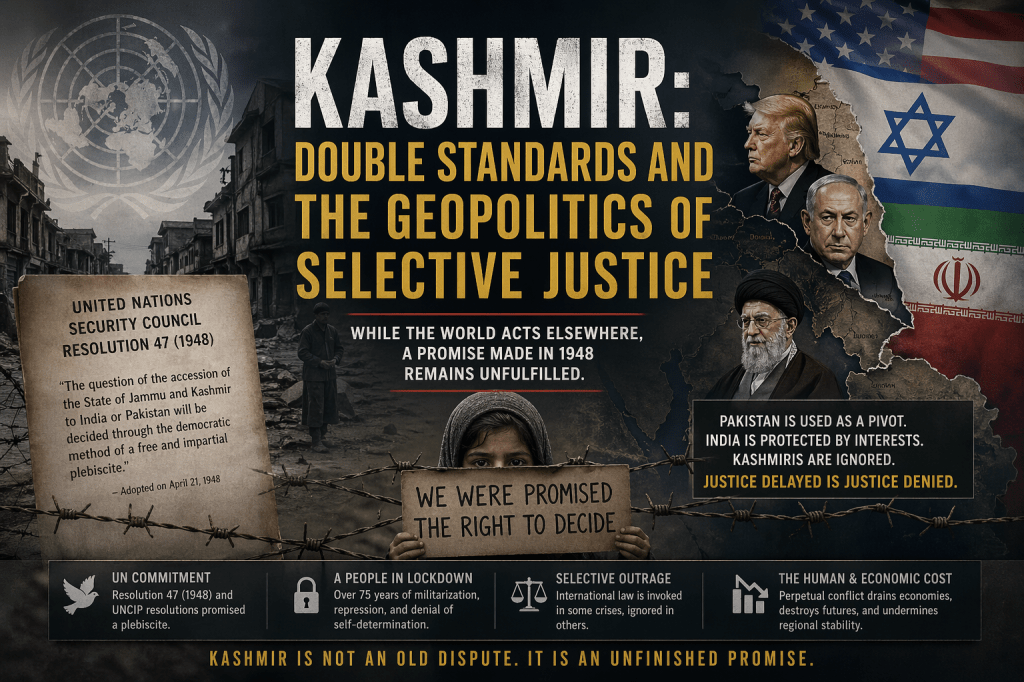
The legal foundations of the Kashmir dispute are neither ambiguous nor outdated. In 1948, India brought the issue before the United Nations, leading to United Nations Security Council Resolution 47, followed by subsequent commitments including United Nations Security Council Resolution 80 and the framework established by the United Nations Commission for India and Pakistan. Together, they laid out a clear, internationally endorsed pathway: ceasefire, demilitarization, and a free and impartial plebiscite to determine the will of the Kashmiri people.
This was not diplomatic ambiguity—it was a binding international commitment to self-determination.
Yet more than seventy-five years later, that commitment has been quietly abandoned in practice, if not in principle.
Instead, the region has been locked into a perpetual ceasefire without resolution—a condition that has served external strategic interests while imposing immense costs on those directly affected. For Pakistan, a state repeatedly drawn into frontline geopolitical contests—from the Cold War to the post-9/11 “War on Terror”—this has translated into profound economic and structural consequences. Resources that might have fueled development have instead been diverted toward security imperatives tied, in no small part, to an unresolved Kashmir conflict.
The result is not merely a frozen dispute; it is a systemic imbalance. A smaller state bears disproportionate economic and strategic burdens, while the underlying political issue remains deliberately unaddressed.
Why?
Because Kashmir sits at the intersection of great power calculations—most notably the rise of China. In today’s geopolitical framework, India is increasingly viewed as a counterweight to China. This has produced a tacit but unmistakable shift: accountability is softened, scrutiny is selective, and longstanding international commitments are quietly deprioritized.
In other words, principles are applied where convenient – and suspended where costly.
This is where the comparison with current Middle Eastern crises becomes unavoidable. When tensions escalate involving Iran, the language of international law, sovereignty, and deterrence is invoked with urgency. Diplomatic channels are activated, red lines articulated, and global attention mobilized.
But in Kashmir—where the United Nations itself prescribed a democratic resolution—there is no comparable urgency. No sustained diplomatic push. No enforcement of commitments. Only a gradual normalization of the status quo.
This is not neutrality. It is selective engagement.
For Kashmiris, the anniversary of Resolution 47 is not a procedural footnote. It is a stark reminder that while their suffering is lived daily, the promise made to them has been subordinated to shifting geopolitical priorities. It underscores a deeper reality: that international law, in practice, often yields to strategic convenience.
The consequences of this are not confined to Kashmir alone. An unresolved dispute between two nuclear-armed neighbors has kept South Asia in a state of permanent instability masked as ceasefire. This has hindered regional integration, discouraged investment, and perpetuated cycles of militarization. The economic trajectory of Pakistan, in particular, cannot be fully understood without acknowledging the structural pressures imposed by this enduring conflict and its geopolitical exploitation.
To ignore Kashmir, therefore, is not to contain a problem—it is to sustain one.
The world cannot credibly advocate for rules-based order in one region while disregarding it in another. Nor can it expect long-term stability from short-term strategic alignments that sideline unresolved conflicts.
Kashmir is not an outdated dispute. It is a test case—of whether international commitments mean anything when weighed against power politics.
More than seven decades ago, the United Nations recognised that the future of Kashmir must be decided by its people. That principle has not expired. It has been deferred.
And in that deferral lies not just the silencing of a people, but the erosion of the very international order that claims to uphold justice, law, and peace.
 Mubeen"s Blog