
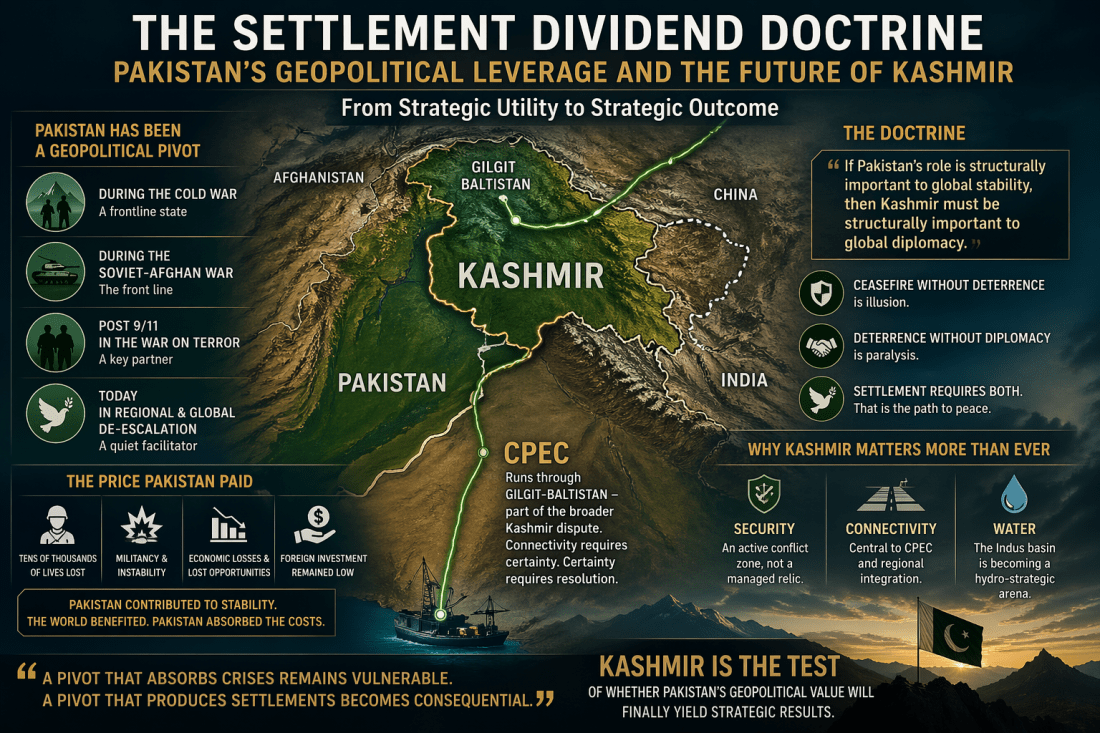
From Strategic Utility to Strategic Outcome
War May Pause. Conflict Does Not.
The uneasy status quo emerging after tensions between the United States and Iran carries an old warning in a new form:
War may have paused.
Peace has not arrived.
What appears as equilibrium is, in reality:
- A ceasefire without settlement
- Deterrence without resolution
- Stability without peace
Pakistan should recognize this pattern.
It has lived it for decades.
A Familiar Pattern—And a Strategic Choice
Pakistan finds itself once again geopolitically relevant:
- In a shifting Middle East
- In great-power competition
- In regional connectivity politics
The question is not whether this relevance exists.
It is whether Pakistan will once again allow it to be used—
or finally convert it into leverage.
That leverage must be directed toward one unfinished strategic question:
Kashmir
Introducing the Settlement Dividend Doctrine
Pakistan should adopt what may be called a:
Settlement Dividend Doctrine
The principle is simple:
Geopolitical contribution must yield geopolitical outcome.
If Pakistan’s role repeatedly contributes to regional and global stability, then the dispute most central to its own security cannot remain permanently deferred.
This is not compensation.
This is reciprocity.
Jinnah’s Vision: Agency, Not Utility
Muhammad Ali Jinnah did not imagine Pakistan as a buffer state.
He envisioned:
- A pivot
- A connector
- A shaper of regional politics
But history transformed that vision.
Pakistan became:
- A frontline state in the Cold War
- A central actor in the Soviet–Afghan War
- A key partner in the post-9/11 order
Each time:
- It contributed to global stability
- It absorbed the consequences
Pakistan did not merely participate in geopolitics.
It paid for it.
The Cost—and the Missed Return
That cost came in multiple forms:
- Militancy and internal instability
- Economic disruption
- Strategic overextension
- Development sacrificed to security
Yet the return has been limited.
Nowhere is this clearer than on Kashmir.
The Missed Precedent: 1962
History shows that geopolitical crises can open space for resolution.
After the Sino-Indian War, the John F. Kennedy administration encouraged movement on Kashmir.
This led to the Swaran Singh–Zulfikar Ali Bhutto talks.
They failed—but they proved a principle:
Moments of crisis can create diplomatic openings on Kashmir.
The present moment may offer another.
Ceasefire Is Not Peace
Pakistan’s experience with India makes one thing clear:
Ceasefires do not resolve conflicts.
They:
- Freeze violence
- Preserve disputes
- Delay resolution
The same applies today globally.
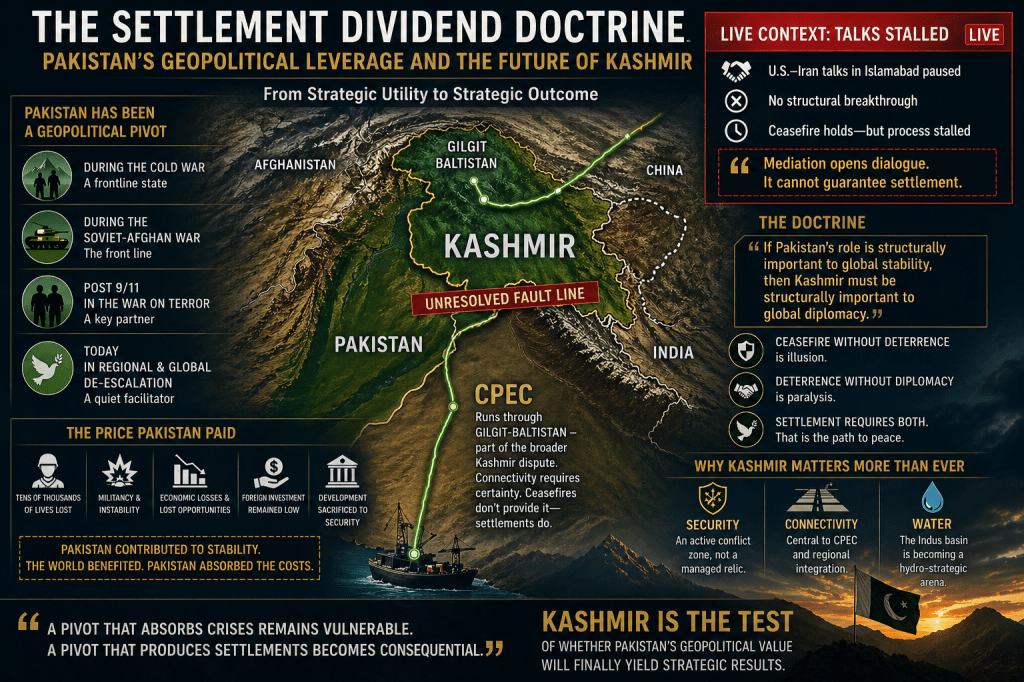
Recent developments surrounding the proposed talks in Islamabad reinforce a central argument of this essay.
The cancellation of the U.S. delegation’s visit and the departure of the Iranian leadership without a second round of engagement highlight a recurring pattern in contemporary geopolitics:
Mediation can initiate dialogue—but it cannot substitute for structural convergence.
Pakistan’s role in facilitating contact between the United States and Iran remains significant. Yet the inability to sustain talks underscores a deeper reality:
- Ceasefires can hold
- Channels can open
- But without alignment on core issues, process collapses into pause—not progress
This is precisely the lesson Pakistan’s own experience with India over Kashmir has long demonstrated.
Decades of ceasefires have:
- Prevented escalation
- But failed to resolve the dispute
- Produced cycles of fragile stability followed by renewed tension
The current moment in U.S.–Iran engagement reflects the same structural limitation.
Dialogue without settlement is diplomacy in suspension.
For Pakistan, the implication is clear:
If its role as a mediator is to translate into lasting strategic relevance, it must move beyond facilitating talks toward embedding its own core dispute—Kashmir—within the architecture of global diplomacy.
Otherwise, Pakistan risks repeating a familiar pattern:
- Enabling negotiations
- Absorbing instability
- But remaining outside the outcomes
The lesson is not that mediation has failed.
The lesson is that mediation without a pathway to settlement is inherently incomplete.
A Strategic Doctrine in Three Lines
Ceasefire without deterrence is illusion.
Deterrence without diplomacy is paralysis.
Settlement requires both.
Pakistan should adopt this as the foundation of its diplomacy.
Kashmir Has Evolved
Kashmir is no longer just a territorial dispute.
Its strategic weight has expanded across three dimensions:
1. Security
It remains an active conflict zone—not a resolved issue.
2. Connectivity
The China–Pakistan Economic Corridor ties Pakistan’s economic future to geography linked to the dispute, especially Gilgit-Baltistan.
3. Water
The increasing politicization of the Indus basin has turned Kashmir into a hydro-strategic issue.
A New Reality
Kashmir now sits at the intersection of:
- Deterrence
- Water security
- Regional integration
- Strategic competition
Settlement is no longer optional. It is structural.
From Utility to Bargaining Agenda
Pakistan must move:
- From grievance → to strategy
- From reaction → to negotiation
- From utility → to leverage
This means articulating a clear position:
No durable regional order can emerge while Kashmir remains unresolved.
This is not coercion.
It is strategic linkage.
The Strategic Choice
For decades, Pakistan has helped manage crises generated by others.
It must now:
- Shape outcomes
- Define terms
- Link its relevance to resolution
That is what a pivot state does.
The Bottom Line
Pakistan has paid the price of being a pivot.
It must now ensure that price yields a return.
A pivot that absorbs crises remains vulnerable.
A pivot that produces settlements becomes consequential.
And no settlement will matter more than:
Kashmir.
 Mubeen"s Blog