Jammu’s Silent Genocide of 1947 and the Politics of Erasure .

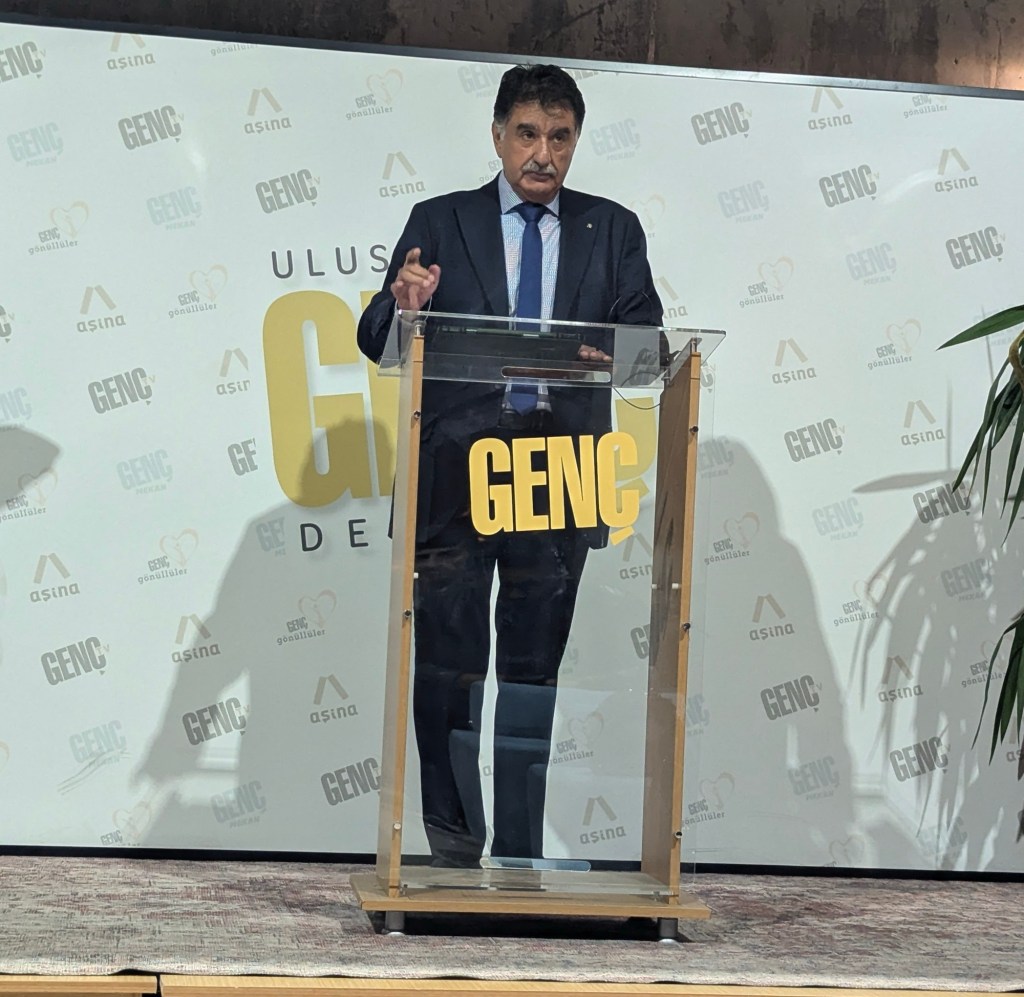
I had the opportunity to speak in a webinar organised by Centre for International Strategic Studies Azad Kashmir ( CISS AJK ) to commemorate the tragic events of November 6, 1947 remembered as the #JammuGenocide .

Herewith below is the speech I made .

Distinguished scholars, respected colleagues, ladies and gentlemen,

I am deeply honored to speak before this esteemed gathering at a time when the world is once again debating the boundaries of justice, memory, and impunity.

Today, I wish to recall an event that remains largely absent from international discourse yet it lies at the heart of the unresolved question of Jammu and Kashmir.

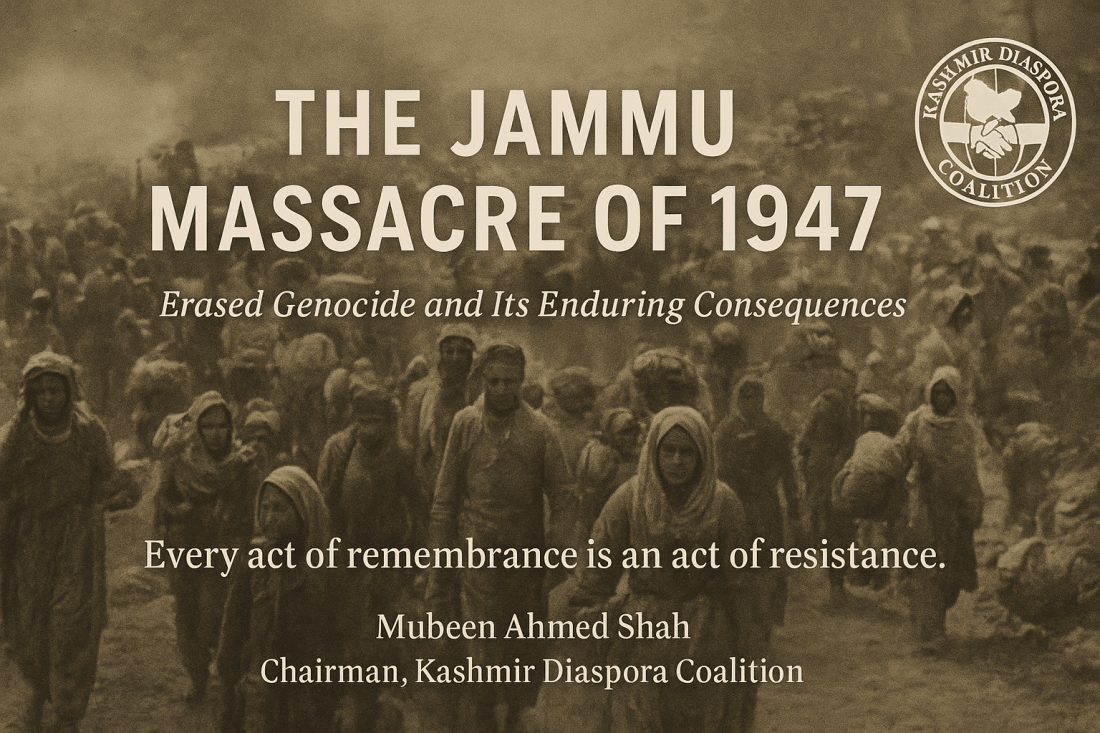
That event is the Jammu Massacre of November 6, 1947 one of South Asia’s earliest and most silenced genocides .

A Silenced Genocide

Seventy-eight years ago, in the autumn of 1947, the plains and hills of Jammu became the site of a planned and systematic extermination of Muslims.

In just a few weeks, between 200,000 and 500,000 people were killed.

More than 700,000 were expelled from their homes and forced across the border into newly created Pakistan.

Entire villages vanished. Families were told they were being taken to safety only to be ambushed and slaughtered on the way to Sialkot.

The perpetrators were not mobs acting in chaos; they were Dogra state forces and Rashtriya Swayamsevak Sangh (RSS) militias operating with coordination and impunity.

The late Ved Bhasin, one of Jammu’s most respected journalists and an eyewitness, wrote:

“What happened in Jammu in 1947 was a systematic and planned massacre of Muslims. It changed the demography of the region forever and yet, it remains

erased from India’s official history.”

His words capture both the enormity of the crime and the scale of its erasure.

The Purpose Behind the Violence

The killings were not random. They had a political and demographic purpose.

Before 1947, Muslims made up more than 60 percent of Jammu’s population.

After the massacre and forced migration, that number dropped to nearly 30 percent transformation so dramatic it could only have been deliberate.

The goal was to permanently alter the demography of Jammu and ensure that any future political arrangement for Jammu and Kashmir would be tilted against its Muslim population.

British records from the time confirm the involvement of the Dogra administration in organising “evacuations” that became instruments of extermination.

Ian Stephens, then editor of The Statesman, described Jammu as “an emptied land.”

It was, in many ways, the first act of structural genocide in the modern history of Kashmir.

Erasure as a Continuation of Violence

What followed was a silence almost as devastating as the massacre itself.

There was no investigation. No memorial. No recognition.

Refugees who crossed into Pakistan and Azad Jammu & Kashmir were stripped of property and citizenship.

Those who remained in Jammu saw their lands confiscated, mosques destroyed or repurposed, and their history erased from the public record.

To this day, no official record, textbook, or state commemoration acknowledges what happened in Jammu in 1947.

This deliberate amnesia is not a historical oversight it is a political decision.

It extends the violence by denying the victims their humanity and the survivors their truth.

Unfortunately our leaders like Sheikh abdullah was responsible for this erasure . We Kashmiris within the valley did not know about the enormity of this for lot of time and I remember that in 2015 Zafar choudhary a journalist published his book

“Kashmir Conflict and Muslims of Jammu, (2015)”” wherein this genocide was described in a detailed manner and I am witness that as a part of civil society organisation we publicly acknowledge as well as asked from forgiveness from the jammu Muslims of not projecting this genocide in our discourses on kashmir .

Today is a good occasion to take that forward .

The Continuum: From 1947 to the Present

The Jammu Massacre did not end in 1947.

Its logic – the logic of demographic domination now re-emerged in the twenty-first century.

When India revoked Jammu and Kashmir’s semi-autonomous status on August 5, 2019, and imposed new domicile and land laws allowing non-residents to settle in the region, it marked the institutionalization of the same project that began in 1947.

The policies introduced since then —land transfers, military colonies, and politically driven redistricting —replicate the demographic engineering first tested in Jammu.

The difference is that what was done with rifles in 1947 is now being done with regulations, bureaucracy, and legal instruments.

This is why we describe the Jammu Massacre not as a single event but as a continuum of structural violence one that connects the past to the present, and erasure to occupation.

Why the World Must Acknowledge Jammu 1947

Despite its scale, the Jammu Massacre has been excluded from global genocide discourse.

Under international law, it clearly meets the threshold of a crime against humanity involving mass killings, forced displacement, and persecution on religious grounds.

Acknowledging this history is not about reopening wounds. It is about naming a wound that never healed.The world cannot uphold the principles of genocide prevention while ignoring one of its earliest and most complete examples in South Asia.

As the Kashmir Diaspora Coalition, we call upon international human rights institutions, scholars, and governments to recognize November 6 as the Jammu Massacre Memorial Day- a day of remembrance and reflection on the cost of silence.

Policy Imperatives

Recognition must be accompanied by action.

A policy paper needs to be formulated , “The Jammu Massacre of 1947: Erased Genocide and Its Enduring Consequences,” which should outline several urgent steps:

1. International Recognition:

Include the Jammu Massacre within UN and global genocide prevention frameworks.

2. Truth and Accountability:

Establish an Independent International Historical Commission on Jammu 1947 to document the massacre through archival and oral evidence.

3. Restitution and Memorialization:

Recognize the rights of displaced families, protect remaining Muslim heritage sites in Jammu, and ensure institutional remembrance through education.

4. Preventing Contemporary Demographic Engineering:

Closely monitor India’s post-2019 domicile and land policies to ensure they comply with international law and human rights norms.

5. Declassification of Archives:

Release British, Indian, and Pakistani archival material that can illuminate the events of 1947 and help build an authentic historical record.

Remembrance as Justice

Ladies and gentlemen,

the denial of justice begins with the denial of truth.

For Kashmiris, remembering the Jammu Massacre is not just about history; it is about survival.

Every act of remembrance is an act of resistance against erasure.

And every act of recognition by the world community is a step toward preventing recurrence not just in Kashmir, but anywhere that power seeks to rewrite the truth of the oppressed.

The Jammu Massacre was designed to erase a people from their land.

To remember it is to refuse that erasure.

To demand justice for it is to insist on the universality of human rights.

Conclusion

As policymakers, scholars, and advocates, we must ensure that the victims of Jammu 1947 are not confined to the margins of history.

Their story is not a footnote to Partition it is a defining chapter in the struggle for dignity and self-determination in Kashmir.Seventy-eight years later, the question before us is simple yet profound:

Will we allow silence to remain the last word on Jammu 1947?

Or will we, at last, give the victims of that genocide the justice of acknowledgment and the power of memory?

Thank you.

27 October 1947 — The Day India’s Occupation of Kashmir

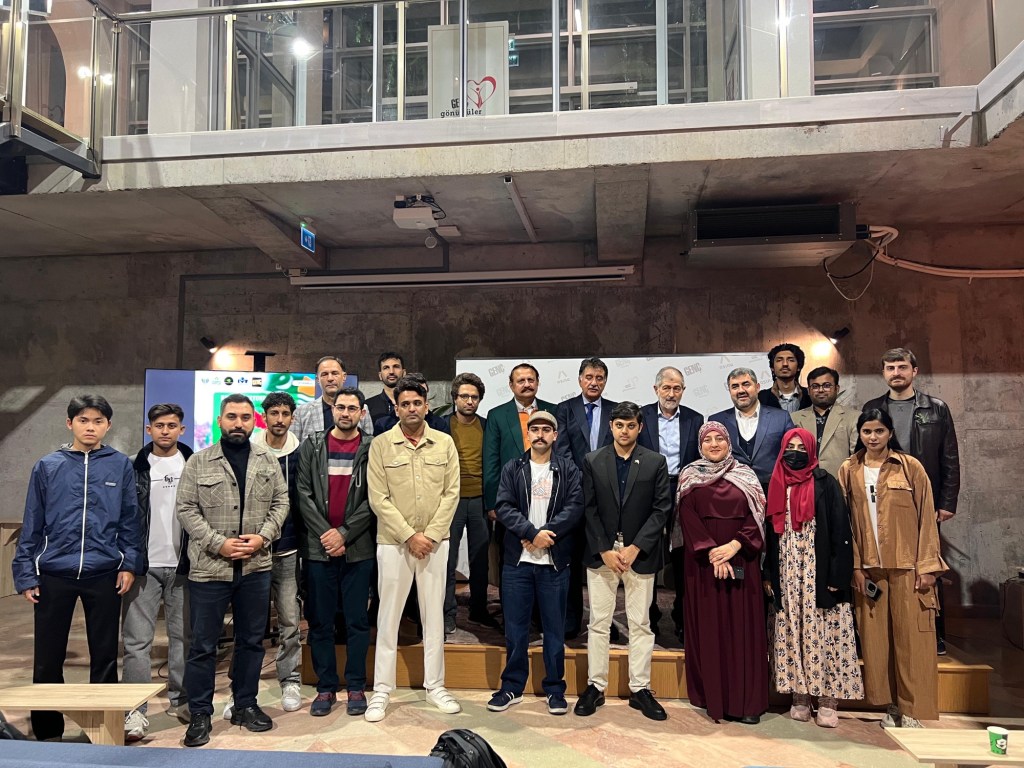
My speech in both Istanbul on 25 th as well as in Ankara on 27 th

Distinguished guests, Excellencies, Brothers and sisters in humanity,

Asalamalikum .

Today, we gather to remember a date that altered the destiny of an entire nation — 27 October 1947, the day when Indian troops landed in Srinagar under the pretext of “assistance” to the Maharaja of Jammu and Kashmir.

For Kashmiris, this was not assistance. It was the beginning of military occupation — an occupation that, seventy-eight years later, continues to shatter lives, suppress freedoms, and defy international law.

Occupation Cannot Be Self-Defence /Counter Terrorism

India has long attempted to justify its military presence in Jammu and Kashmir through the language of self-defence and counterterrorism including narrative terrorism. But as we all know, occupation cannot be self-defence or counterterrorism or even the new labelling they are promoting of narrative terrorism by which they are putting behind bars anyone who speaks out besides registering police reports (FIR) to every section of our society .

Under Article 51 of the United Nations Charter, the right of self-defence applies only when a state faces an armed attack from another state. Once a state occupies a territory, its actions there are governed by the law of occupation — a principle affirmed by the International Court of Justice in its 2004 Wall Advisory Opinion.

The Legal Framework and the Broken Promise

The United Nations Security Council, through Resolution 47 of 1948, affirmed that the future of Jammu and Kashmir was to be decided by a free and impartial plebiscite. India’s entry into the territory was accepted by the UN based on that condition. That promise was never fulfilled. Articles 1(2), 2(4), and 55 of the UN Charter enshrine the right of peoples to self-determination and prohibit the acquisition of territory by force.

The ICJ Namibia Advisory Opinion of 1971 reaffirmed that unlawful occupation cannot confer sovereignty.

The denial of the right of self determination/ plebiscite has resulted from 1947 ,killing of more than about 6-700000 Kashmiris if not a million, 150000-500000 civilians arrested from time to time , 8500 -10000 custodial killings, 12000 disappearances, 110000 structures destroyed/ arsoned, 11,170 rape cases, with injured running in hundred of thousands with at least 7000 with pellet injuries and out of them at least 700 with eye injuries resulting in blindness of different levels. Besides we have about 20000 widows as well as 1500 half widows while the number of orphans are more than 120000 .

Occupation Disguised as Counterterrorism including narrative terrorism

Over the decades, India has sought to rebrand its occupation through the lexicon of counterterrorism. The Fourth Geneva Convention and the Hague Regulations are explicit: the acts of an occupying power are regulated by international humanitarian law, which prohibits collective punishment, arbitrary detention, and restrictions on political expression. Hundreds of political leaders, human rights defenders, and youth languish in prisons across India — from Tihar in Delhi to Agra and Kot Bhalwal — imprisoned under draconian laws such as the UAPA(Unlawful andprevention act ) and PSA.(Public safety act ) which are called out by amnesty international as lawless laws .

The Case of Yasin Malik and Political Prisoners besides human right defenders

Yasin Malik, Chairman of the Jammu and Kashmir Liberation Front, who chose the path of non- violence and dialogue, is now condemned to lifeimprisonment. Alongside him, leaders such as Shabir Shah, Ashiq Hussain Faktoo , Asiya Andrabi, Masarat Alam, and Nayeem Khan remain silenced.

In case of Shabir shah he has spent more than 33 years in jail while Ashiq hussain Fakhtoo 34 ,Masarat alam 30 years .

Besides we have one of our well know human right defender Khurram pervaz in prison for last 4 years while as another well know human right defender Mr Muhammad Ahsan Untoo has been in and out of prisons and has spent his 30 years of life in Indian prisons .

In international law, such political leaders are protected persons, not criminals.

Human Rights Violations Under Occupation

The ongoing violations in Kashmir breach the ICCPR( International covenant on civil andpolitical rights ) CAT ( committee against torture ) CEDAW (convention on elimination of all forms of discrimination against women ) and CRC( Convention on the rights of children )Arbitrary arrests, torture, and denial of education to children continue. The UN Working Group on Arbitrary Detention and the OHCHR have repeatedly called attention to these abuses.

The Right to Resist Occupation

UNGA Resolutions 1514 (XV) and 2625 (XXV) affirm that peoples under foreign domination possess the right to self-determination, including the right to struggle to achieve it. The 1977 Additional Protocol I to the Geneva Conventions recognises such struggles as legitimate, not terrorism.

Double Standards in International Justice

“The world’s double standards on justice have not only deepened the suffering of occupied peoples but also eroded faith in the rule of international law itself.”

Around the world, we see that the principles of international law are invoked selectively — applied to some, denied to others.

When Russia invaded Ukraine, the International Criminal Court moved within months, issuing arrest warrants and mobilising global condemnation.

Yet, when the people of Gaza are bombarded or when Kashmir has lived underoccupation for seventy-eight years, the same institutions fall silent.

This is not only hypocrisy — it is the collapse of the very idea of universal justice.

As highlighted in recent international legal commentaries, the system of accountability has been captured by power politics: those with vetoes in the UN Security Council or strategic alliances with powerful states are shielded from scrutiny.

If international law is to have meaning, it must apply equally — from Kyiv to Gaza to Srinagar.

Kashmir cannot remain an exception to the world’s conscience. The credibility of the entire international order depends on ending this selective enforcement and holding every occupying power to the same legal and moral standard.

Accountability and International Responsibility

The Rome Statute defines torture and denial of fair trial as war crimes. Universal jurisdiction allows any state to prosecute such crimes. The 2018 and 2019 OHCHR reports urged creation of a Commission of Inquiry into violations in Jammu & Kashmir which never happened .

Call to Action: Restoring Integrity to International Justice

To correct this global hypocrisy, we must call upon both governments and people of conscience to act:

1. Governments must uphold consistency in international law — the same principles invoked in Ukraine must be applied to Kashmir and Gaza. Selective justice erodes the very legitimacy of the global legal order.

2. Member States of the UN must move beyond the paralysis of the Security Council and activate the UN General Assembly to establish independent investigative mechanisms for Kashmir under the principle of universal jurisdiction.

3. Countries of the Global South — from Türkiye to South Africa, from Malaysia to Latin America —should unite to demand reform of international justice institutions so that no power, however large, remains above the law.

4. Civil societies and individuals must insist that their governments end complicity through silence — by conditioning partnerships, trade, and security cooperation on adherence to human rights and humanitarian law.

5. The international legal community — scholars, jurists, and human rights defenders — must treat Kashmir as a living test of whether law or politics governs the world order.If the world could act with urgency in Ukraine, it cannot turn away from Kashmir.

Justice cannot depend on geography, religion, or power — it must depend only on truth.

Generations in Captivity

Entire generations have grown up under curfews and fear. The trauma of seventy-eight years cannot be measured in statistics alone.

Checkpoints replaced schools with almost every far flung villages have these check points at the start and end of villages , graveyards replaced playgrounds.

The Moral and Legal Imperative

The occupation of Jammu and Kashmir is a test of the international legal order. States have an ergaomnes (rights are owed towards all ) obligation to ensure respect for international law. Silence in the face of such violations is complicity.

Closing Appeal

India cannot claim self-defence or terrorism of any type while occupying Kashmir. It cannot imprison an entire people and call it peace. And it cannot criminalise the dream of freedom — a dream that began long before 1947 and will not die behind prison walls.On this 27th of October, as the world observes Black Day, let us reaffirm that occupation cannot outlast the will of a people determined to be free.

The world may have forgotten, but Kashmir has not .

And as long as justice remains denied, the voice of Kashmir will continue to echo — in Srinagar, in Istanbul, in London, in washington as-well as Johannesburg and all over the world and in every conscience that refuses to accept silence as peace.

From Palestine to Kashmir: The Cost of Global Silence

A Warning Ignored

The tragedy unfolding in Gaza today did not happen overnight. It is the result of decades of deliberate inaction. The world allowed Israel to defy UN resolutions, to expand settlements, to entrench occupation, and to silence Palestinian voices under the guise of “security.” Each time, international leaders responded not with action, but with calls for “dialogue” and “bilateral negotiations.” The result has been catastrophic: a population pushed to the edge of survival, mass displacement, cultural erasure, and today, one of the worst humanitarian disasters of our time.

For Kashmir, this is not just a warning. It is a mirror.

Kashmir’s Broken Promises

When the United Nations first addressed the Kashmir conflict in 1948, it recognized the territory’s disputed status and called for a free and impartial plebiscite to determine its future. India and Pakistan both agreed in principle. Yet more than seven decades later, no plebiscite has been held.

Instead, the world has fallen into the trap of bilateralism—the idea that India and Pakistan must resolve Kashmir through direct talks, with the UN standing aside. This framework has failed at every stage:

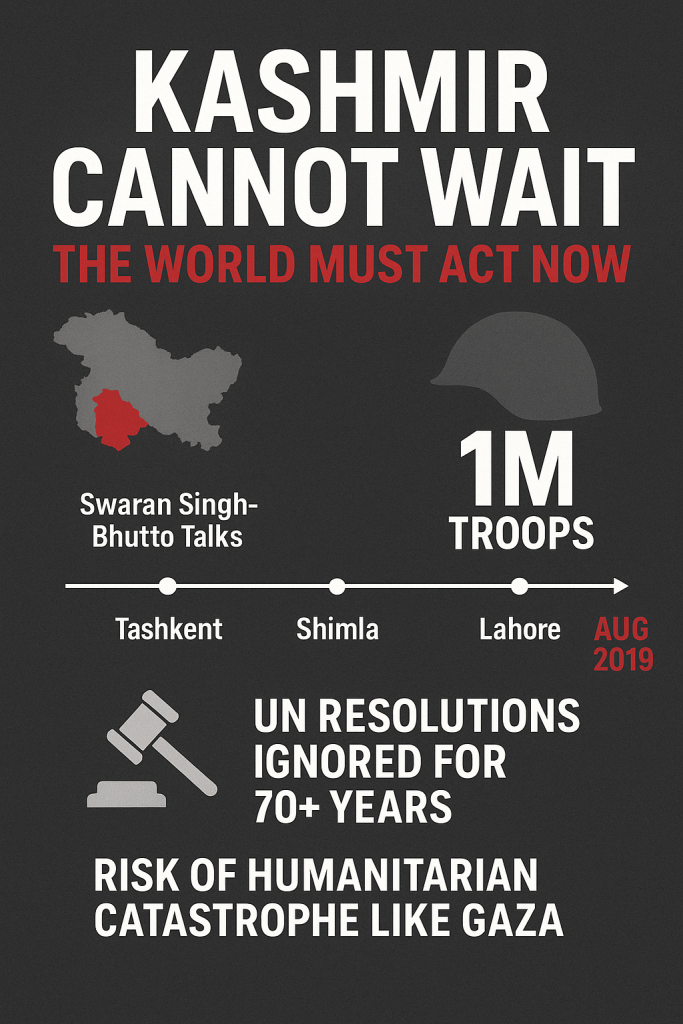
• 1962–63: Swaran Singh–Bhutto Talks — brokered by the United States and Britain after the Sino-India war, these talks sidelined the UN resolutions and set the dangerous precedent of “bilateralism.”

• 1966: Tashkent Agreement — a ceasefire, but no progress on Kashmir.

• 1972: Shimla Agreement — India insisted Kashmir was a purely bilateral matter, effectively freezing UN involvement.

• 1999: Lahore Declaration — derailed by the Kargil conflict.

• 2001: Agra Summit — collapsed after last-minute Indian resistance.

Each attempt ended the same way: India buying time while tightening its grip on Kashmir.

The End of Autonomy

The last decade has made clear that India is not interested in a negotiated solution. In August 2019, New Delhi unilaterally abrogated Article 370 of its Constitution, stripping Jammu and Kashmir of the limited autonomy it had left. This was done under military lockdown, with mass detentions of political leaders, journalists, and civil society activists. Internet shutdowns silenced dissent. New domicile laws opened the door to demographic engineering, threatening to permanently alter the Muslim-majority character of the region.

Today, nearly one million Indian troops are stationed in Kashmir—making it the most militarized zone in the world. Reports of custodial torture, enforced disappearances, and extrajudicial killings continue to surface. Books are banned, online archives erased, and Kashmiri culture is under systematic assault.

Yet the world looks away. Just as it looked away from Palestine.

The Failure of Bilateralism

Bilateralism has not just failed—it has been weaponized. India invokes it to block international scrutiny, while refusing to negotiate in good faith. Kashmiris themselves have been excluded from these talks altogether, treated as objects of negotiation rather than subjects with rights.

More than 65 years after Swaran Singh and Bhutto sat across the table, it is obvious: bilateralism is dead.

Lessons from Palestine

The Gaza catastrophe shows what happens when the international community substitutes “dialogue” for accountability. By treating Israel as above international law, world powers allowed the situation to spiral until it became almost irreversible. Sanctions, boycotts, and diplomatic isolation should have been imposed decades ago. Instead, the world normalized occupation, and now we are left with genocide.

Kashmir risks the same fate. If the world continues to hide behind “bilateralism” and economic partnerships with India, it will one day awaken to a tragedy beyond repair.

The Case for Sanctions

The time has come to move beyond empty resolutions and statements of concern. Targeted sanctions against India are both morally justified and strategically necessary.

Sanctions can take many forms:

• Diplomatic: Suspension of high-level visits, exclusion from forums until compliance with UN resolutions.

• Economic: Restrictions on arms sales, high-tech exports, and trade privileges.

• Cultural & Academic: Visa bans on officials implicated in human rights abuses; suspensions of joint cultural and academic projects.

This is not unprecedented. The world united to impose sanctions on Apartheid South Africa, despite powerful Western business lobbies opposing them. Sanctions helped isolate the regime and empower the global anti-apartheid movement. The same must happen with India.

Grassroots efforts—such as boycotts, divestment, and sanctions (BDS) campaigns—has to be put in place . But without state-backed measures, the impact will remain limited. What is needed is political courage from governments and multilateral bodies, beginning with the OIC, the UN Human Rights Council, and sympathetic nations in Europe, Africa, and Latin America.

The Moral Imperative

Silence is complicity. The UN Security Council once promised Kashmiris the right to self-determination. That promise has been betrayed for more than 70 years. Meanwhile, an entire generation has grown up under siege, denied basic freedoms, and told that the world has forgotten them.

If the world had acted earlier in Palestine, Gaza might not be burning today. If the world acts now in Kashmir, perhaps it can still prevent another catastrophe.

Conclusion

The choice is stark. Continue to hide behind bilateralism, and watch Kashmir slide into permanent occupation, cultural erasure, and large-scale violence. Or act decisively—through sanctions, international accountability, and renewed insistence on UN resolutions—to honor the promises made to Kashmiris.

Kashmir cannot wait another decade. The cost of silence is too high.

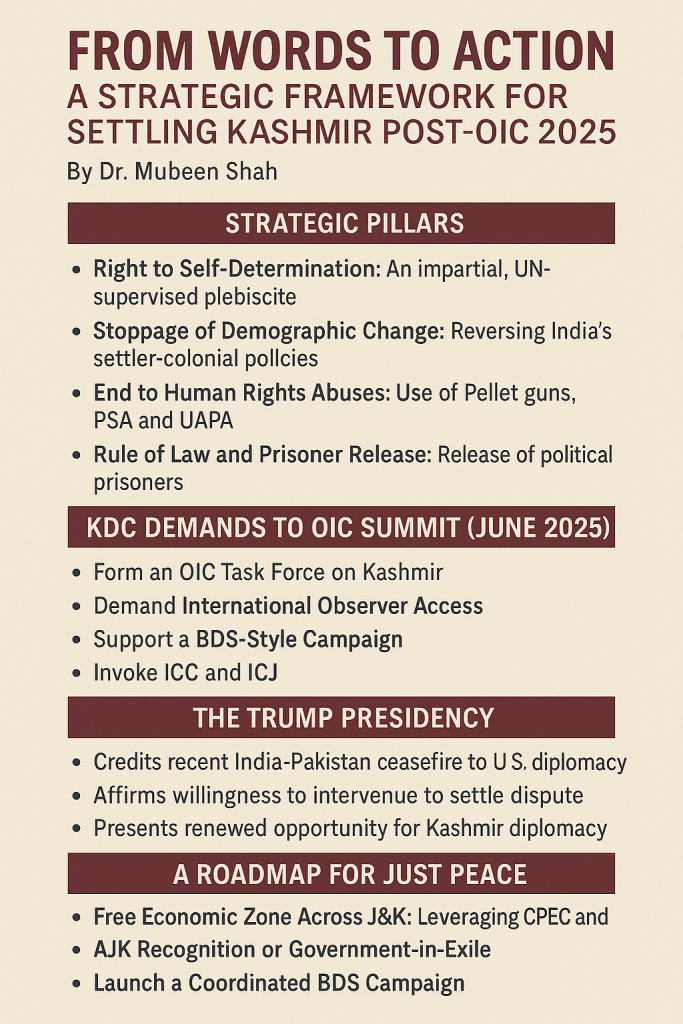
From Words to Action: A Strategic Framework for Settling Kashmir

By Dr. Mubeen Shah

Introduction

On July 13, 2025, the Indian state exposed the hollowness of its claims over Kashmir when Omar Abdullah, the present chief minister and mainstream political figure, was blocked from visiting the Mazar-e-Shuhada in Srinagar. This act symbolized the complete closure of civic space, even for those previously aligned with the Indian state ( whom Kashmiris at large label as collaborators ). It reminded the world that Jammu & Kashmir is not a functional democracy but a territory under permanent emergency, characterized by surveillance, demographic engineering, and suppression of political agency.

The incident occurred after almost a month ( precisely 19 days after )Organization of Islamic Cooperation (OIC) held its 51th Session of The Council of Foreign Ministers in Istanbul , where Kashmir was discussed with renewed urgency. On that occasion, the Kashmir Diaspora Coalition (KDC) of which I am presently the head submitted a response which was communicated to the OIC urging the OIC to move beyond symbolic resolutions toward action rooted in international law and moral responsibility.

Today escalating India-Pakistan tensions, and increased Kashmiri diaspora mobilization, the moment has arrived to implement a comprehensive roadmap for just peace in Kashmir.

Strategic Continuity: A Framework Rooted in Justice

I had made some proposals regarding the strategic framework I first articulated in 2020 kashmir-regional-and-international-dimensions ( https://economykashmir.home.blog/2020/07/02/kashmir-regional-and-international-dimensions/ ) elaborated further in model-of-settlement-of-kashmir( https://economykashmir.home.blog/2020/07/01/model-of-settlement-of-kashmir/ ) while participating in zoom calls and which are documented .

The core principles I laid out in 2020 remain unchanged and now gain deeper international legitimacy:

1. Right to Self-Determination:

Enshrined in UN Resolutions 47 through 122, this principle is non-negotiable. It calls for a UN-supervised plebiscite—a promise the world has yet to fulfill.

2. Stoppage of Demographic Change:

The systematic dilution of Kashmiri identity through the Domicile Law is a violation of the Fourth Geneva Convention. India’s settler-colonial project must be reversed.

3. End to Human Rights Abuses:

India must halt its use of preventive detention laws like PSA and UAPA, and lift the military siege that has turned Kashmir into an open-air prison.

4. Prisoner Release and Rule of Law:

Kashmiris imprisoned since the abrogation of Article 370 & before that date must be released. India’s courts have failed to uphold even basic liberties; international mechanisms must now intervene.

The Trump Presidency: A Renewed Window for Diplomatic Intervention

The return of President Donald Trump to the White House in 2025 has reshaped the strategic context of Kashmir diplomacy. In a recent statement, President Trump publicly claimed credit for the latest ceasefire between India and Pakistan, describing it as the result of “quiet but firm American diplomacy.” More importantly, he signaled that his administration is willing to directly intervene in the Kashmir dispute, reviving his 2019 offer of mediation.

Unlike previous administrations that deferred to India’s “bilateralism” narrative, Trump views the Kashmir conflict through the lens of deal-making and global conflict resolution. His political persona, centered around decisive interventions and legacy-building, creates an unexpected yet powerful opening.

For Kashmiri diplomacy, this presents a unique opportunity:

• The current ceasefire creates breathing room for pushing confidence-building measures such as prisoner release, demilitarization, and international access.

• The Trump administration may be persuaded to back a regional economic framework—including my longstanding proposal of a Free Economic Zone across both sides of J&K—to position Kashmir as a peace corridor.

• The Diaspora particularly the Kashmiri-American diaspora and advocacy allies must immediately ramp up engagement with this administration, framing Kashmir not as a liability but as a peace dividend for South Asia and U.S. strategic interests.

Whether one agrees with Trump’s politics or not, his presidency offers a renewed diplomatic window—one that must be seized with urgency, focus, and realism.

The Path Forward: A Phased, Practical Roadmap

1. Free Economic Zone for Entire J&K

My longstanding proposal for designating both Indian- and Pakistani-administered Kashmir as a Free Economic Zone (FEZ) has gained renewed urgency. With CPEC gaining momentum and China’s increased interest in regional stability, declaring both AJK (Azad Kashmir ) and IOJK ( Indian occupied Jammu Kashmir ) as FEZs:

• Provides economic hope to the youth.

• Positions Kashmir as a bridge for peace rather than a nuclear flashpoint.

• Creates conditions for functional autonomy pending political settlement.

2. Recognition of AJK or Government-in-Exile

If India refuses international access and dialogue:

• Pakistan must consider declaring Azad Jammu & Kashmir an independent state, much like the PLO or Palestine, and seek international recognition.

• Alternatively, a Government-in-Exile should be declared, possibly based in Turkey or Malaysia, with representation from AJK and the global Kashmiri diaspora.

3. Mobilize Legal and Institutional Mechanisms

• Engage the International Criminal Court (ICC) for war crimes in Kashmir.

• Move to the International Court of Justice (ICJ) through friendly states (e.g. Gambia, Malaysia) to challenge India’s demographic changes and use of torture.

• Highlight misuse of PSA and UAPA as violations of civil and political rights.

4. Launch a Global Kashmir BDS Campaign which I had written in 2020 also (https://economykashmir.home.blog/2020/07/04/kashmiri-bds-boycott-divestment-sanctions-movement-against-india/)

Inspired by the Palestine solidarity movement, we must:

• Target international firms complicit in surveillance, arms sales, or occupation infrastructure.

• Picket and pressure entities investing in Kashmir’s illegal colonization.

• Use diaspora networks to stage global campaigns in front of consulates, corporate offices, and international forums.

5. Harness Cultural Resistance

• Support musicians, filmmakers, writers, and athletes who carry the Kashmiri story into the global conscience.

• Build platforms for young Kashmiri voices to counter the Indian state’s disinformation.

• Commission new works of resistance art and documentary journalism.

Conclusion: This Is the Moment to Act

History is shaped by those who combine moral clarity with strategic foresight. For too long, Kashmir has been trapped between rhetorical support and geopolitical compromise. But the global shift in perception—helped by the COVID-era understanding of lockdowns, the Ukraine war’s reminder of international double standards, and the enduring Palestinian struggle—has opened space for Kashmir on the world stage.

The world can no longer ignore the reality of Kashmir.

The time for resolutions alone is over. The time for actions rooted in justice, rights, and international law has begun.

Let us move from words to action—together.

My participation in the International Virtual Convention on 21st of January 2024

I attended last night the above convention in presence of galaxy of speakers .

I tried to communicate in a structured manner our pain ,Muslim world pain ,the need of Pakistan to become truly the citadel of Islam in regard to #Palestine & #Kashmir .

Although I was able to speak almost everything in my allotted time but I am putting up this post for conveying the whole with the underlying reasoning .

AsalamAlikumAs a Kashmiri I would like to give my view on all the three points under discussion.

Please bear with me

  1. Turmoil in Pakistan and its effect on the region
  • India has taken the most advantage of the situation in Pakistan particularly by the actions they are taking in Kashmir & unfortunately not talked about much by the world as well as for that matter in Pakistan except for lip service – a) the occupation has been strengthened by manipulation and getting the Supreme Court of india confirm the action of 5th august 2019 of the modi govt .as their Supreme Court is an extension of the executive particularly when it comes to Kashmir proved no of times in the execution of Maqbool Bhat & Afzal Guroo . b) further strengthening of the occupation by india of putting their plans of creating settler colonies just like Israel has done with the latest announcement of land allotments to retired Indian army personnel in the form of Sainik colonies which already had Sainik farms besides land for their different divisions as well as other lands c) The denial of the right of self determination has resulted in particularly from 1990 ,killing of more than 100000 Kashmiris ,150000 civilians arrested, 8500 custodial killings, 12000 disappearances, 110000 structures destroyed/arsoned, 11,170 rape cases, with injured running in hundred of thousands with at least 7000 with pellet injuries and out of them at least 700 with eye injuries resulting in blindness of different levels. Besides we have about 20000 widows as well as 1500 half widows while the number of orphans are more than 120000 and the prevalence of PTSD ( post traumatic stress disorder ) in hundreds of thousands of Kashmiris of all age groups . By adding all these figures and keeping in view our society having a minimum 10 family members resulting in that our 4.5 million people have been effected directly . The above situation is enough to invoke Article 2 of the Genocide Convention that there is a genocide going on in Indian occupied Kashmir . Some countries like South Africa have shown the way to go to ICJ while as Mexico & Chile has gone to ICC in case of Palestine .
  • On one side of the fulcrum Pakistan has a running policy of no trade with India after August 2019 & rightly so although the Kashmiri view at that time and still is that it should have been more as I pointed out to khan sahib when I met him last year in Zaman park . Now there is a talk of starting trade etc Unfortunately Pakistanis do not learn from history . No amount of talks or expectation of reinventing the wheel by doing trade can change Indian policy until and unless a strong leadership is in place who can see eye to eye and have the courage to expose the hindutva agenda or islamaphobia regime presently in place in India .
  • That the attack on a nuclear power Pakistan by Iran was intended to send clear messages to the United States and its allies, not least Israel, is hard to dispute.
  • We know who benefited from 9/11 . At this time in the world particularly in our region it is a similar situation. After 9/11 , 6 countries were demolished & destroyed. Now they have started in Gaza
  • Iran fired missiles on Pakistan & Pakistan fired back rightly to protect each other’s sovereignty. Yet when the sovereignty of our holy mosque Al Quds is violated, nothing is done.
  • I fear the region as well the Muslim world is going to suffer if we do not have a leadership in Pakistan who carries weight not only in the region but the world particularly when the economy of Pakistan is in dire straits .
  • Being a businessman without a stable environment no investments will come & the vision of Pakistan as the citadel of Islam will be a pipe dream .

2.Impact of Imran Khan on Muslim world/Region

  • Imran Khan, as the Prime Minister of Pakistan, has influenced the Muslim world and the region in several ways. His leadership has been characterized by efforts to foster diplomatic relations and promote peace. Khan sahib has been vocal on issues like Islamophobia which culminated in the UN declaring a day of 15th March as a day Islamophobia worldwide, Kashmir conflict, advocating for the rights of Kashmiris. Additionally, he has played a role in facilitating dialogues between Muslim-majority countries.( As per media even been able to break the ice between Iran & Saudia Arabia)
  • How Israel took advantage of the situation of a leadership vacuum in Pakistan who could have been a strong voice in OIC which could have been different as with their relentless war against Gaza which is going on with at least 32245 Palestinians (including 12660 children , 6860 women ) have been killed, over 62634 injured, 72440 homes destroyed completely besides 190250 buildings partially damaged .
  • The most unapologetic Muslim leader who spoke against the indirect American interference in Muslim nations unlike many Arab leaders who have accepted the American hegemony.
  • It is important that in the Muslim world there is a need to have a strong voice to add to the other strong voice like President Erdogan of Türkiye where I live whose people are behind him .
  • IT IS IMPORTANT TO RECOGNISE THIS AS THERE IS A PATTERN OF GLOBAL ASSAULT ON ISLAM…. PALESTINE , KASHMIR,ROHINGYAS,EAST TURKMENISTAN,CHECHNYA,BOSNIA are examples . The pattern has been described in detail if we study
  • DOCTRINE OF DISCOVERY.
  • THE LAUSANNE DECLARATION
  • CONFESSIONS OF AN ECONOMIC HIT. MAN
  • GENERAL WESTMORELAND EXPOSE OF THE PENTAGON PLANS TO DESTROY AND DESTABILIZE THE ENTIRE MID EAST.
  • CHRISTIAN ZIONISM .
  • CLASH OF CIVILIZATIONS BY HUNTINGTON
  • The Strengths of a State are Rule of Law and its ability to respond to UN Charter obligations.
  • State should not be seen fragile and failing to uphold the human rights and the constitutional guarantees. State should be seen administering rule of law and not persecuting Imran Khan.
  • Imran Khan has a constituency at home and abroad. Due regard should be given to it. I would like to recall that recently I met a Palestinain activist who told me in my discussion that in the Islamic world voice of Mahathir Mohammad is heard besides President Erdoğan & lamented the absence of Khan sahib whose voice would have changed the response of the Islamic world in regard to Gaza . This is a Palestinian talking .

3.Impact of cyphergate on US Pakistan relations

  • There is a difference in the perception of the public which I got living in Türkiye wherein I saw that Pakistanis when they meet me here or I met them on my visit to Pakistan that America was considered not an enemy but not a friend also but after cyphergate it is now perceived to be an enemy by interfering in the internal affairs of Pakistan.
  • The truth is that Khan sahib has few friends in the West after prioritizing relations with Russia and China. “From a Washington perspective, anyone would be better than Khan,” says Michael Kugelman, the director of the South Asia Institute at the Wilson Center in Washington, D.C. The policy of prioritising was correct as we know how India took advantage at least with Russia economically .
  • I would like to tell the Kashmir perspective about What is the US Policy on Kashmir as it is important also to know the possibility of how the Pakistan America policy plays out as it is an important component of the relationship
  • – I as a person do not know for certain as they have a clear cut policy in case of Palestine but the policy on Kashmir is not yet clear completely.
  • In case of Palestine , America is Israel and Israel is America which is clear by their actions in the ongoing Gaza war with openly vetoing of ceasefire, no accountability of Israel when they are doing Genocide of Palestinians.
  • In case of Kashmir it has not reached a stage of that America is India or India is America yet .
  • My personal experience of getting release from Indian jails because of pressure primarily by America through senate hearings etc which put enough pressure on the Indian govt to release me showed at that time that the policy is try to act on human rights vis a vis Kashmir but not doing it in the case of persons like Khurram Pervaz since then reflects in either change of policy after need of India against China or enough pressure not put on the institutions in America like it was just after August 2019
  • Double speak in regard to human rights and false narrative building has been exposed of America in the case of Palestine & although in Kashmir they are publicly not yet doing the same .
  • One of the most important false narratives promoted and supported by America is labelling freedom fighters in Palestine or Kashmir as terrorists while as previously they in case of Afghans when they were fighting the soviets or Foreigners in Ukraine fighting the Russians as freedom fighters which exposes the hypocrisy.
  • America has not kept its commitment of getting settlement of Kashmir as per aspirations of Kashmiri people which was promised to General Ayub Khan so that Pakistan does not attack India when China attacked india in 1962 . The model of talks , talks and talks as has been the case of Palestine without any result .
  • After 1947 initially America was supporting our position , they were even sponsors of the resolution but unfortunately with time although they are not completely against but do not act as they should have for implementation of the UNSC resolutions
  • Keeping the above in view what will be the effect of cyber gate on the relationship between Pakistan America relationship can be imagined .
  • Is there any leader who can tell them the above facts in regard to kashmir and that also publicly
  • Who will talk to them on an equal footing and absolutely not basis to safeguard the sovereignty of Pakistan . People of Pakistan need to decide it decisively. Our basis of Kashmir settlement is on the basis of Right of Self Determination & certainly Pakistanis need to decide for themselves how they need to be governed & not only be a developed nation with dignity and honour but the citadel of Islam for which it was created .

Middle East , India & Pakistan: Conflict & Conflict resolution vis a vis Kashmir .

I had the opportunity to do an interview which was taken by Dr Munawar Hussain ( Assistant Professor from Qaid – Azam University Islamabad ) published on 7 th January 2024 .

I am sharing the you tube link https://youtu.be/uzm7XWNGzz8?si=ZUkqQJdcrPpk3V7S of the same .

The total interview touches three main components

  1. Present situation in Kashmir
  2. In changed world scenario what will the Kashmiri Diaspora do
  3. What options are available for Pakistan as well as Kashmiris .

1.Present situation in Kashmir

With what has happened in Gaza which shows resonance in Kashmir as we have suffered in similar manner with the difference that Israel has completely bombed Gaza while as India has not done that although half of Kashmiris living in the valley have directly got effected ( The denial of the right of self determination has resulted in particularly from 1990 ,killing of more than 100000 Kashmiris ,150000 civilians arrested, 8500 custodial killings, 12000 disappearances, 110000 structures destroyed/arsoned, 11,170 rape cases, with injured running in hundred of thousands with at least 7000 with pellet injuries and out of them at least 700 with eye injuries resulting in blindness of different levels. Besides we have about 20000 widows as well as 1500 half widows while the number of orphans are more than 120000 .
 
These figures suggest more than 450000 families have been directly affected by the all-out war imposed on Kashmiris by India.
 
Given that Kashmir is a closely knit society, the number of people directly affected by this ruthless war is not less than 4.5 million keeping in view that with each family 10 is the minimum effected strength per family .)

Our freedom fighters are slowly and steadily now copying the Hamas model . Until now they have not attacked Indians in mainland India which has never been the case . If they are pushed to the wall we fear that they may do it . What will happen after that ?? India may react in the same way as Israel did and what will happen then . The difference in Gaza and kashmir is that Gaza is surrounded by countries who are not capable of fighting Israel but in our case Pakistan is a nuclear country capable of fighting India . The previous Prime Minister of Pakistan ( Imran khan ) quite explicitly warned the world community if a situation occurs where Pakistan has to fight it may be a fight to the last & we can understand the consequences of a NUCLEAR WAR .

India unfortunately did not agree to the model which we had proposed of a Free Economic Zone for both sides of Kashmir when I was the President of Kashmir Chamber of Commerce & Industry from 2006-2009 , as well as when I was President of the Joint Chamber Of Commerce & Industry from 2012-2014 . That was one of the models of peaceful settlement of kashmir as we had suggested that the sovereignty issue be delayed for 5,7 or 10 years . This model would have given connectivity in the region and beneficial for both countries .

This model has been buried as such by the action of Mr. Modi on august 5th 2019 . We have to understand that diluting of 370 was started by the congress which did it subtly while BJP did it openly . What is the result of all this is . Issuing of domicile certificates in hundreds of thousands besides the model of settler colonies like Israel . The settler colonies will take different forms ( settler colonies of domicile certificates issued , Sainik colonies based on retired army personnel who have done duties in Kashmir , Pandith colonies . ) The fear is that with the train connecting Srinagar to other parts of India , thousands can be shifted to Kashmir from india .

With the new laws in place where landless people can be given small plots for settling / building houses there will be one fine day juggies made by these landless transported from India .

These people will be promised free land and housing . India has tried a model of increasing Amarnath Yatra pilgrims which in my childhood used to have pilgrims in hundreds and maximum thousands but now more than 700000 with free travel and free food provided by big Indian corporations in the form of langars along the route of amarnath .

  1. In changed world scenario what will the Kashmiri Diaspora do :

I am of the opinion that because of what happened in Gaza , Kashmiris who bear arms want to take Kashmir liberation forward .

The double standards of the world particularly the west is also on the mind of such people . In Ukraine people were asked to go to fight Russia and called freedom fighters while as in Gaza as well as Kashmir they are called terrorists which is part of the Islamophobia worldwide . The result of this is that people like us will go the background while as people who bear arms will be at the forefront of the freedom movement. Because of double standards of the west we even if getting the opportunity to talk to such people cannot convince that their way is wrong and our peaceful way is better .
Unfortunately the world powers trapped by sex scandals and exploited by countries like Israel to dictate policies of these leaders and India has also followed the Israeli model helped particularly by the need of the west to stop China . With no recourse to a world based on rules , world has not stopped india in the genocide they have done in kashmir as they have not stopped Israel in the case of Gaza .

  1. What options are available for Pakistan as well as Kashmiris .
    Although an has a limited option and as I told in pakistan on my visit that Pakistan has to make its mind and do if india stops water or attacks lahore . If they consider Kashmir as their part they have to walk the talk and we do not see the previous action repeated like refusing to go to war in 1962 or even recently when the previous chief is on record as per our information in media etc that the pakistan army was not ready to go to war because of gaps in equipment or even the supply of diesel etc .
    Kashmiris will never compromise on their right of self determination.

OIC & KASHMIR

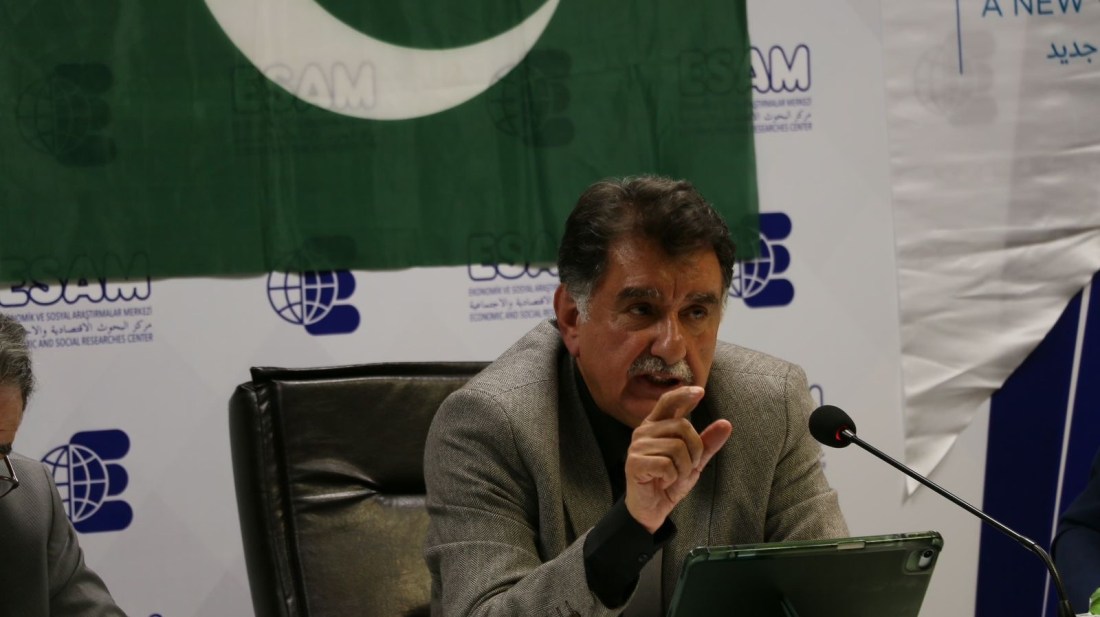
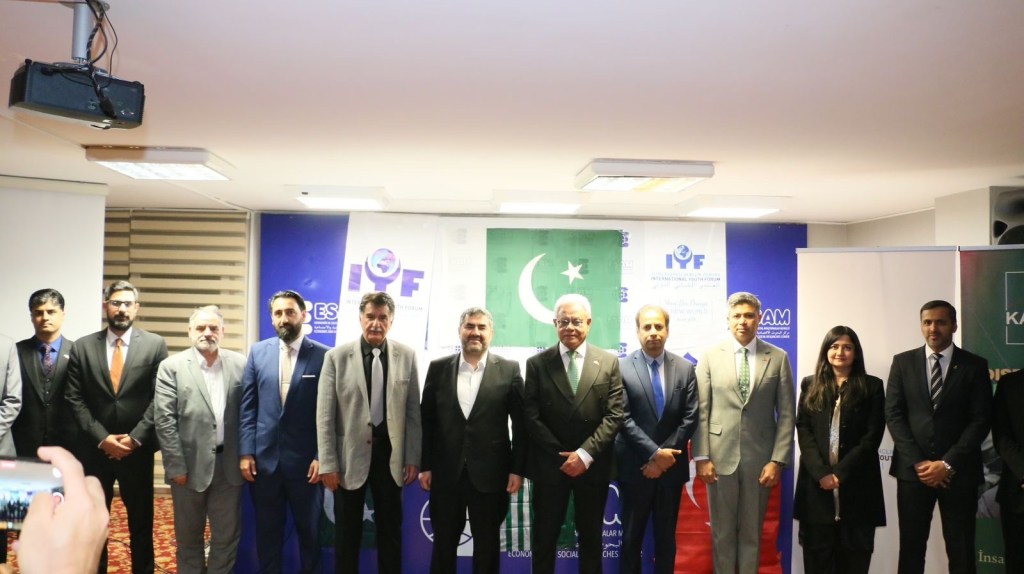
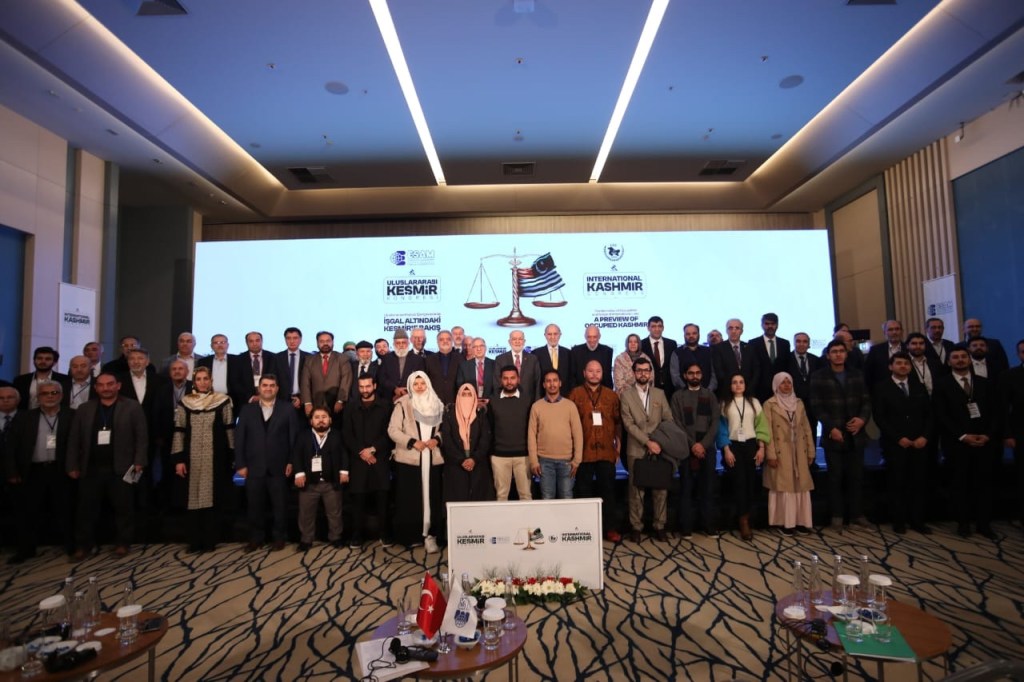
Speech in Meeting in Ankara with OIC ambassadors as a part of program organised by ESAM & LFK ( Legal Forum kashmir) – INTERNATIONAL KASHMIR CONGRESS

Ustad Recai Kotan President of ESAM. ,

Tenet karaamloglu President of Sadat party , Ambassador of Iran and other distinguished guests , ladies & gentlemen:

1) A Joint Communique was issued by the OIC Contact Group on Jammu and Kashmir (Islamabad, 22 March 2022) 1)The communique among other things contained the Action plan of which I would like to point out the following

a) In their bilateral engagements with India, raise the Jammu and Kashmir dispute to advance a peaceful resolution in accordance with UNSC resolutions – ( Kashmiri Right of Self Determination) which is the foremost human right violation which India is doing and all other human right violations are because of the denial of this one

b) Conduct visits at the level of Permanent Representatives to obtain firsthand information about the situation in Jammu and Kashmir on both sides of the Line of Control.

c.) Constitute a panel of international eminent personalities with a view to exploring legal, political and diplomatic avenues for peaceful settlement of Jammu and Kashmir dispute; d.Monitor, raise awareness, advocate and highlight the Jammu and Kashmir dispute in its various dimensions in line with their respective mandates.

All the above may not have the result we desire until and unless we go to the jugular and that is in the present world order the action of sanctions which is what America and Europe is putting on Russia without any unanimous resolution of the UN while as in our case there is a clear cut resolution not being implemented for the last 75 years .

(Double standard – our freedom fighter are called terrorist while people are encouraged to go to Ukraine to fight Russia & are called freedom fighters )

2) Relief to Kashmiris who are in the countries of OIC in the form of safeguarding them from any action by india if they do activism for kashmir

3) The possibility of giving relief in form of citizenship or permanent residency to Kashmiris who have are in need of the same

4) Jobs for Kashmiris in their economies by giving a special dispensation to people from Indian occupied kashmir

5.) To give funds for providing scholarships to deserving students in various fields within their country as well as European and American university

6.) To allow Kashmiris to educate the people of these countries regarding the kashmir issue in the right perspective – by facilitating the setting up of a KASHMIR HOUSE type of facility which will promote the culture , arts and crafts as well as the political aspects of kashmir .

7)India is on a major propaganda offensive to convince the world that its brutal occupation & repression in Kashmir are part of the epic battle against Muslim terrorism—an epic battle that is completely manufactured to justify war, occupation, genocide.””” We need to fight this in all its manifestations and at every forum

8)ICCPR (The International Covenant on Civil and Political Rights is a multilateral treaty adopted by United Nations General Assembly Resolution 2200A (XXI) on 16 December 1966, and in force from 23 March 1976 in accordance with Article 49 of the covenant.”” The laws of PSA , UAPA , Sedition laws applied by india needs to be studied by this moot / meeting in regard to contravention of the ICCPR

9)OUR PEOPLE ARE LOOKING FOR SETTLEMENT THROUGH UN , RELIEF THROUGH INTERNATIONAL CRIMINAL COURT & INTERNATIONAL COURT OF JUSTICE

TIME IS RUNNING OUT . IF THERE IS DELAY IN STOPPING INDIA IN THEIR NEFARIOUS DESIGN WE WILL HAVE KASHMIR BUT WITHOUT KASHMIRIS

ANKARA DECLARATION

Ankara, Turkey. December 11, 2022

Ankara Declaration
International Kashmir Congress

“International Kashmir Congress is something that we should be very proud to have been associated with. Hopefully, we can look back on this conference as a turning point in the struggle for Kashmiri liberation. It became clear in the course of the many excellent presentations that International Law and the UN authority should be effective in liberating Kashmir. But a realistic view is that International Law and the UN cannot be effective unless they are politically implemented. Under these circumstances the civil societies throughout the world have a huge role to play in shaping a political strategy that complements the legal analysis, and finally brings justice to the people of Kashmir. To achieve liberation for Kashmir depends above all on fulfilling the inalienable right of self-determination, which has been withheld by India for 75 years.” Prof. Richard Falk

Three days international Kashmir Congress was held in Ankara turkey. I have the honor of releasing the “ANKARA DECLARATION” to the press as the chairman of congress as well as the Executive Director of Legal Forum for Kashmir. Advocate Nasır Qadrı

We the representatives of the people of Indian Occupied Jammu & Kashmir, along with those in solidarity in Ankara, Turkiye, as well as academicians and researchers and particularly victims of occupation, oppression and settler colonialism in Palestine and elsewhere, solemnly declare that:

From 9th December to 12th December 2022, we participated in the conference titled ‘The narrative of occupation and scopes of international law: A preview of Occupied Kashmir’ organized under the auspices of International Kashmir Congress held in Ankara, Turkiye.
That international community has failed the people of Indian occupied Kashmir for many decades.
That India has flagrantly violated international law, norms, conventions, and treaties in the course of implementation and its unlawful occupation, with the criminal intention of colonizing and annexing Kashmir.
That the Indian state is aggressively pursuing a fascist agenda in occupied Kashmir and has been perpetrating the war crimes, crime against humanity and crime of aggression and doing so with total impunity and zero accountability.
India, which is an electoral autocracy, has been cynically deceiving the world by adhering to the empty forms of democracy, peace and justice without any intention of acting in conformity with these ideals, it has done this to hoodwink international community into believing that the fate of Kashmir is subject to India’s legitimate authority which in reality is manipulated by its fake constitutionalism.
That India in continuation of its colonial project has deprived the Kashmiri people of the mirage of limited safeguards that were derived from United Nation Security Council resolutions (UNSC);
That India had long been brutally repressing the movement for exercise of Kashmirs’ human rights, above all the inalienable Right to Self-determination; India has relied on intense coercion ever since 1947, these policies were intensified by the decrees put into effect by India in August 2019.
We reject India’s aggression, illegal occupation, coercion, and denial of the sacred right of self-determination in all forms.
That we implore the international community finally to act in accord with the principle of ‘Injustice anywhere is threat to justice everywhere’.
That we, the Kashmiris, victims of India’s aggression are duty bound to protect our land, people, culture and freedoms and uphold rights as guaranteed by international law.
That the indigenous population is under threat and has every right and duty to resist oppression and uphold the rights of self-defense against the perpetrators of ‘Crimes against humanity’, ‘War crimes’ & ‘Crimes of aggression.’
That the failure of international community and its institutions in occupied Kashmir are discrediting the UN, drawing into question its very existence and validity.
That India disregards and undermines the international justice system which is encouraging fascists, autocrats and aggressors throughout the world, likewise, to oppress freedoms and violate International human rights, international humanitarian laws and International criminal law.
That the UN Charter which describes and mandates intervention in case of violation of international peace and security should abandon double standards and discriminatory enforcements and it is long overdue that the Charter be implemented in occupied Kashmir to the full extent of the law.

That in Kashmir’s rightful and long struggle for self-determination we appeal and advocate unconditional solidarity by the International community and urge an immediate end in aiding and abetting India’s atrocities, crimes and Human rights violations and act in accordance with its moral and legal responsibilities, not only for the sake of the long-suffering people of Kashmir, but for the benefit of all peoples throughout the world that seek a just world order based on the observance of the rule of Law and respect for the rights of all.””

I also participated in the same and spoke on the first day .

“Ustad Recai Kotan President of ESAM. ,
Tenet karaamloglu President of Sadat party , Ambassador of Iran and other distinguished guests , ladies & gentlemen:

  • A Joint Communique was issued by the OIC Contact Group on Jammu and Kashmir (Islamabad, 22 March 2022) 1)The communique among other things contained the Action plan of which I would like to point out the following a. In their bilateral engagements with India, raise the Jammu and Kashmir dispute to advance a peaceful resolution in accordance with UNSC resolutions – ( Kashmiri Right of Self Determination) which is the foremost human right violation which India is doing and all other human right violations are because of the denial of this one . b.Conduct visits at the level of Permanent Representatives to obtain firsthand information about the situation in Jammu and Kashmir on both sides of the Line of Control. c.Constitute a panel of international eminent personalities with a view to exploring legal, political and diplomatic avenues for peaceful settlement of Jammu and Kashmir dispute; d.Monitor, raise awareness, advocate and highlight the Jammu and Kashmir dispute in its various dimensions in line with their respective mandates.
    All the above may not have the result we desire until and unless we go to the jugular and that is in the present world order the action of sanctions which is what America and Europe is putting on Russia without any unanimous resolution of the UN while as in our case there is a clear cut resolution not being implemented for the last 75 years .

(Double standard – our freedom fighter are called terrorist while people are encouraged to go to Ukraine to fight Russia & are called freedom fighters )
2) Relief to Kashmiris who are in the countries of OIC in the form of safeguarding them from any action by india if they do activism for kashmir
3) The possibility of giving relief in form of citizenship or permanent residency to Kashmiris who have are in need of the same
4) Jobs for Kashmiris in their economies by giving a special dispensation to people from Indian occupied kashmir
5.) To give funds for providing scholarships to deserving students in various fields within their country as well as European and American university
6.) To allow Kashmiris to educate the people of these countries regarding the kashmir issue in the right perspective – by facilitating the setting up of a KASHMIR HOUSE type of facility which will promote the culture , arts and crafts as well as the political aspects of kashmir .

7)India is on a major propaganda offensive to convince the world that its brutal occupation & repression in Kashmir are part of the epic battle against Muslim terrorism—an epic battle that is completely manufactured to justify war, occupation, genocide.””” We need to fight this in all its manifestations and at every forum
8)ICCPR (The International Covenant on Civil and Political Rights is a multilateral treaty adopted by United Nations General Assembly Resolution 2200A (XXI) on 16 December 1966, and in force from 23 March 1976 in accordance with Article 49 of the covenant.”” The laws of PSA , UAPA , Sedition laws applied by india needs to be studied by this moot / meeting in regard to contravention of the ICCPR

9)OUR PEOPLE ARE LOOKING FOR SETTLEMENT THROUGH UN , RELIEF THROUGH INTERNATIONAL CRIMINAL COURT & INTERNATIONAL COURT OF JUSTICE

TIME IS RUNNING OUT . IF THERE IS DELAY IN STOPPING INDIA IN THEIR NEFARIOUS DESIGN WE WILL HAVE KASHMIR BUT WITHOUT KASHMIRIS

Kashmir: Demystifying India as a neo-colonial power*

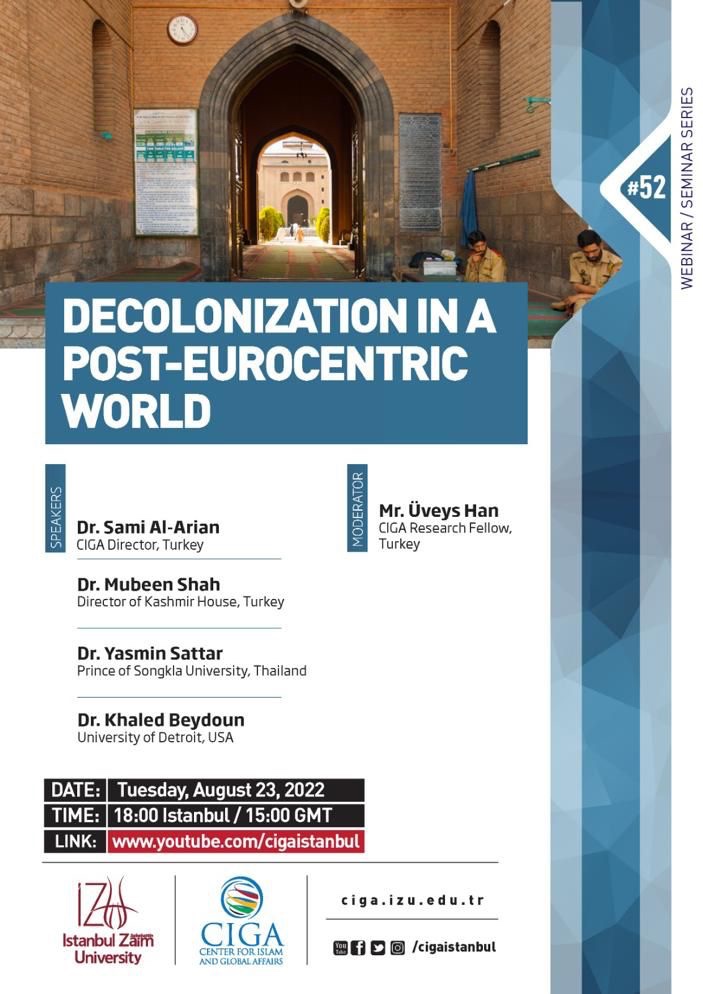
I attended a webinar held by Ziam university Istanbul Turkey which was on “”DECOLONIZATION IN A POST -EUROCENTRIC WORLD “ and I spoke on the colonisation of kashmir by india . It is a pleasure to speak on the subject of decolonization which people in Kashmir are seeking for the last 75 years from India.

India is the present neo-colonialist and has put in place in Kashmir laws and ways by which Indian citizens can migrate to and settle in an area which for all international norms is a foreign land for them.

Lorenzo Veracini, an eminent writer on colonialism, has written in his essay on “Kashmir: Is it Settler Colonialism?” that the changes done specifically by India in 2019 with regard to Articles 370 & 35A of their constitution unilaterally in ways that could be enabling a settler colonial moment.

Both the ancient Greeks and the Romans practiced colonialism and settler colonialism as distinct modes of domination, and both developed specific ways to refer to a remarkable variety in the relationships linking colony and metropole.

India overtook Kashmir during partition of the sub-continent and its aftermath, but while it exercised forcibly a control of all external relations, it did not enact an undifferentiated citizenship – the two Indian constitutional provisions mentioned above ensured that the polities remained distinct.

They shared institutions, but no isopolity was established – no common citizenship was enforced.

Specifically, Indian citizens did not acquire the ability to exercise in Kashmir what the Roman constitutions defined as commercium and connubium – terms the Latins used to indicate inherent rights to residency and to hold property.

Articles 370 and 35 A were constitutional obstacles to their acquiring commercium and connubium rights in the subordinate polity were formally removed.

In the settler colonial polities, individuals and collectives move and immediately acquire rights to hold property, and especially real estate, and to transfer to their children political rights that are normally preserved for natives.

India’s control of defense, external affairs, and communications made Kashmiris a domestic dependent nation within the Indian federal state, but Articles 370 and 35 A ensured a limited sovereignty within a wider sovereignty.

The property rights of recognized permanent residents were constitutionally protected, and there were other protections in education and in the administration of the state (some fiscal benefits were also granted).

The coming isopolitical arrangements sound democratic, but they are not – the Indigenous peoples of the world are rightly suspicious of the rule of settler colonial majorities and rightly seek constitutionally enforceable protections (in 2007 the UN also issued a Declaration on the Rights of Indigenous Peoples).

Settlers can now ‘indigenize’ – the distinctive mark of all settler colonial regimes – especially if they hold ‘domicile’ documents.

The newly introduced legal category of ‘domicile’ is especially typical of a settler colonial regime, as it renders permanent residency certificates irrelevant or obsolete.

‘Domicile’ is designed to undermine the claims to indigeneity that Kashmiris have traditionally and jealously defended.

The settler collective aims to turn itself into a ‘native’ polity.

Recent developments under the BJP Indian federal administration include the aggressive promotion of Hindu pilgrimages to Kashmir, and an emphasis on the presence in Kashmir of ancient Hindu temples.

‘Muslims’ in the region are routinely represented as an exogenous collective that ‘conquered’ the land in historical times – that is, Muslims are presented as a collective that cannot rightfully claim an authentic form of indigeneity. ( which in itself is a wrong narrative as Islam spread in kashmir not by conquest but by the work of sufis who came to the region with the arrival of many Muslim Sufis preachers from Central Asia and Persia, beginning in the early 14th century.)

Now talking about the laws through which they dominate:

Take, for example, the law called Unlawful Activities (Prevention) Act. This law has been regularly deployed against Kashmiris and many have been imprisoned under it which runs into thousands . One of the clauses of this law penalizes any act or speech that “creates disaffection against India”.

Can a colonized population feel, or express, anything besides disaffection for the colonizing nation?

As a result, under this law, resistance against colonization inevitably becomes an act of terrorism.

So, the function of Indian law in Kashmir is not, and cannot be, the dispensation of justice, or the provision of rights. Rather, the entire juridical apparatus stands to criminalize resistance to Indian colonization, decriminalize or conceal the violence of the Indian state against the Kashmiri population, and help the Indian state in projecting an image of its rule in Kashmir as one marked by commitment to principles of justice.

Or take the example of Armed Forces (Special Powers) Act (AFSPA). The AFSPA provides the Indian troops with powers to “shoot to kill, conduct warrantless searches, and detain people arbitrarily”, all of which they have regularly done.

India’s colonization of Kashmir is not typified by militarization and forced cultural assimilation alone.

It is, first and foremost, characterized by the power the colonial-state wields to kill subject populations at will, without being subject to any rule other than the will itself.

Now, it has introduced a new set of domicile laws which allow Indian citizens to permanently reside and buy land in Kashmir if they have worked in the region for fifteen years or studied there for seven years.

Recently, their election commission has decreed any person can vote for local elections if they are living ordinarily in kashmir and give up their right to vote from the place they have migrated for work , jobs including working in the Indian army ( which is estimated to be from 900000- 1 million )

It is estimated that about 2.5 million people will be added which will be more than 30-35% increase in people eligible to vote and thereby control the political set up while as the laws they have changed in august 2019 they slowly are controlling the economic spaces in Kashmir.

So, the only consideration that dictates what the Indian state does in Kashmir is the question of what is necessary for the sustenance and continuity of occupation? As written by a Kashmiri young writer Ahmed Bin Qasim in an article in TRT on 20th April 2021

Sometimes, it is the application of the law, and sometimes, its suspension. Sometimes, it is the carrot that is effective, and sometimes, the stick. And sometimes multiple forms of power are deployed simultaneously.

Living under colonialism, one learns that the lawmaking in the assembly, the courts of the occupation and the gun of an army man work in tandem, constantly overlapping and reinforcing the other.

Now, the question is how to decolonize and make the world community understand that India is the neo-colonial power in South Asia, notwithstanding its deceitful narrative of the biggest democracy in the world which is exposed by the above description I have made and then make the people of the free world know about all this in all fora in the way a common man will understand on the streets of Europe and America which as such for the present control the geopolitical situation in the world which has been although dented recently in the Ukrainian war where a multipolar world is trying to shape up although India with its deceitful way of diplomacy which in their parlance is called Chanakya Neti trying to play both sides by which to a large extent by which they have dented the sanctions imposed on Russia.

For us, the only hope in this geopolitical war of domination is China which with all its warts and issues particularly Uyghurs is relevant in this issue and could be our saviour to finish this colonialism of India as by doing that and intervening in Kashmir they will safeguard the most important route of CPEC (China Pakistan Economic Corridor) being the best way to undo the shackles of the USA in South East Asia through the potential blockage of Johor Straits for Chinese trade and shipping .

Economic Implications of India’s Illegal Measures in Indian Occupied Kashmir

I attended a webinar on 4 th August 2022 arranged by the Pakistan embassy in Belgium and spoke on the above subject .

The illegal changes india has done in Kashmir , it has been doing for a long time which has now become more blatant & is what occupiers do & have done to strengthen their occupation which in turn has effected the economy for a long time before august 2019 and continues .

1. Control of land & Occupation

This has been done in different ways like acquiring land for various reasons on the name of development and security reasons . The J&K government when headed by Mehbooba Mufti admitted in the state assembly that during (2015-2018) more than 4.3 lakh kanals (53750 acres ) of land in J&K is under the illegal occupation of Indian army and other military forces stationed in the state. The Jammu Kashmir Coalition of Civil Society (JKCCS) indicates that the current deployment of regular Indian army and other forces in J&K is estimated to be over 700,000 personnel turning the region into the largest militarized deployment in the world, with one armed personnel for seventeen civilians. Also, there are studies that suggest presence of Indian troops, with a ratio of one soldier for every eight Kashmiris . Moreover, there has been an emergence of a new form of military, multilateral, and humanitarian occupations that reinforces institutionalized vehemence against occupied people .

The stationing of this colossal army has resulted in the land grab of diverse topographies, including forests, hills, glaciers, mountains, stream beds, paddy fields, and peripheries of lakes, in both urban and rural settings, thereby establishing permanent military structures. The exact figure of land under Indian armed forces in J&K may be even higher as huge chunks of the area remain illegally occupied, which was never officially demarcated, requisitioned, leased, mutated, or attained under the J&K Land Acquisition Act .

A classical example of land grab by the army is shown by the occupation of Tatoo grounds a 200 acres in the centre of the city and where a garrison is in place . The army took replacement of it in Shariefabad some two decades back but still occupies this place . Being an economic space the Kashmir Chamber was at the forefront for asking it back but inspite of agreement of the army in 2015 with the then mufti syed govt it still remains in occupation .

The JKCCS documents also show that the occupation is not limited to land only, but also includes 1,856 buildings, including 1,526 private buildings, 280 government buildings, 14 industrial units, give cinemas, and 28 hotels. The irony is that most of the owners of these establishments have not been paid rent and that whenever the military has paid rent, it is negligible compared to the real worth of the property under the occupation. The Public Commission on Human Rights in 2005 identified 46 schools and educational establishments occupied by armed forces .

Indian authorities have furthered the occupation by acquiring land through agencies such as the National Highway Authority of India, Indian Railways, and others in the name of improved connectivity and development. There have also been forcible land acquisitions for projects including highway and railways .

In a report by the Oakland Institute Research Team USA , in context of scrapping of the Article 370, the researchers call the investment could be a “Trojan horse for forcing the demographic composition of Kashmir” and adds that this move resembles to that of the “illegal Israeli settlements in Palestine’s West Bank”

The government of India is using occupation as a tool to disempower residents of Kashmir. As stated above, military rule has systematically furthered the land grab, making inhabitation hard for the locals and rendering the population dispossessed. In Kashmir almost every village at the entrance and exit there are army camps or drop gates even .

2. Hydro-economics and confict .Jammu & Kashmir’s rights over one of the most precious natural resources, water capital, were taken away by New Delhi through the Indus Water Treaty of 1960, which was mediated by the World Bank. The International Water Management Institute has stated that the Indus Water Treaty deprived J&K state of approximately 6500 crore (800 million dollars ) annually, and that the treaty has negatively affected the power-generation and agriculture-potential of the state .

New Delhi’s apparatus through which the state controls resources like water includes India’s hydropower generation company, National Hydro Power Corporation (NHPC). New Delhi owes 20000 crore ( about 2.5 billion) to J&K State for using their water as a reparation for the power-generated from their resources. The occupation of our resources particularly our power generation from our water resources which is under their central govt companies ( NHPC Limited (erstwhile National Hydroelectric Power Corporation) . This company has an asset base of 97 billion dollars with a yearly income of 710 million dollars . One third of its generating capacity is in kashmir and has rightly got the name of “EAST INDIA COMPANY “ in kashmir .Kashmir chamber of which I was head from 2006-2009 had been fighting regarding return of our assets which they built with or without agreement of limited time but never returned to the state although different commissions like RANGARAJAN COMMISSION recommended return of some projects .While our industry and business are reeling under power cuts they are by occupying our most important resource earning and becoming big corporations with profits besides we are incurring losses which is further depriving us economically .

3. Economic losses .The economic losses businesses had to incur because of extended curfews and Hartals particularly from 1990’s were more than 3600 days which have been lost ( which roughly means 10 years ) , the magnitude of which the world can understand with LOCKDOWNS done under Covid where strong economies of the world like USA , Canada as well as Europe are reeling

In the latest press report on December 2021 the losses calculated by the Kashmir chamber , Kashmir has suffered a loss of around Rs 50,000 crore ( 5 .5 billion dollars ) since 5 August 2019 . This is loss calculated for two years and multiply it by at least 5 times if not more giving us a figure of 200000 crore rupees . ( 27.5 billion dollars ) This is only from 1990 and not to speak from 1947 because of non settlement of kashmir as per aspirations of the people

This has also effected in number of ways Our people like :

—who invested in industries particularly from the 1990’s became sick because of the prevailing situation in kashmir because of frequent curfews and Hartals which were done as a form of resistance to different terrorist actions by the Indian forces wherein it is estimated that about more than 3600 days have been lost in the last thirty years which was further accentuated by the action in august 2019 and subsequently by covid . The world can understand it more with the experience of covid lockdowns as explained previously above . We lost more than 10 years in closure of last 30 years . You can realise that how businesses can survive and lot of them have become bankrupt.

Now by the change of laws after 2019 the big corporates of India will buy these assets at rock bottom prices and occupy our economic places .

I am reminded by a personal episode I got to know in 1993 when I went to buy Brass handicraft items from Moradabad . The items are manufactured by Indian Muslims while the traders are mainly Hindus . This has happened by cyclical religious riots where usually & invariably Muslims suffered and they remained the workers while the main profits were taken by the traders . This is what is going to happen in kashmir .

——In kashmir lot of local assets have been created on leased properties particularly in resort places like Gulmarg and pahalgam whose leases are not being renewed & the option of owning by locals have purposely not been done previously although there are numerous cases in even New Delhi where such properties were converted into ownership. . Now by withdrawing the 35A on 5 th august 2019 we fear they will be handed over to the big corporates of india and Kashmiris in their own country will become servants and second rate citizens

——-The latest law of land use where agriculture land can be used for non agriculture use thereby making a way for land to be taken over by corporates from India

——Already unfortunately our waqf properties were taken over by the state by one of the previous regime of Mufti Syed on the pretext of corruption but we now realise that it was done under a plan to disempower Kashmiri Muslims.

4. Control over financial institutions . The Indian state, over decades, has gradually and systematically used numerous measures to ensure economic imperialism of the J&K, which has included control over of the local financial institution, the Jammu and Kashmir Bank Limited (JKB). The state administrative council headed by the previous J&K governor S.P. Malik has turned JKB into a Public Sector Bank, which has meant taking away its independence. The bank has lost all its autonomy that it used to derive under the Article 370. Also, the bank has undergone much restructuring, and all the shareholding that the state used to own are now owned by New Delhi since the revocation of the Article.J&K bank was in 1990’s made strong by local people in transferring their assets to the bank instead of Indian banks and by the change of law the whole has been reversed .

While occupying our economic spaces India has done the biggest human right violation of not providing KASHMIRI RIGHT OF SELF DETERMINATION & We cannot forget that it has resulted from 1990 a human catastrophy resulting in more than 100000 killed , 150000 civilians arrested ,8500 custodial killings , 12000 disappearances , 110000 structures destroyed / arsoned ,11,170 rape cases , Injured will be running in hundred thousands with at least 7000 with pellet injuries and out of them at least 700 with eye injuries resulting in blindness of different levels besides the above financial implications .