
The ceasefire involving Iran, Israel, and the United States was never a resolution. It was a pause.
What has followed makes that clear.
Diverging interpretations, continued military activity, and the collapse of negotiations all point to a deeper reality: the region is not failing to communicate. It is failing to sustain agreements.
A Ceasefire Without Structure
Within hours of the ceasefire, its contradictions were evident.
Iran treated it as conditional and region-wide.
Israel continued to operate with flexibility, particularly in Lebanon.
The United States accepted ambiguity as a tool of temporary de-escalation.
This is not miscommunication. It is the predictable outcome of an agreement without enforcement.
The Shift to Chokepoints
As diplomacy stalls, the conflict is moving into a new phase—one defined by leverage over critical systems rather than direct confrontation.
Nowhere is this clearer than the Strait of Hormuz.
Here, escalation is no longer about territory. It is about the ability to disrupt global energy flows and impose economic cost.
Each actor is constructing its own deterrence:
- Iran through economic chokepoints
- Israel through military dominance
- The United States through naval projection
But these are not coordinated. They are parallel—and that makes them unstable.
The Agreement That Already Existed
There is a deeper irony at the heart of the current crisis.
Many of the demands now being placed on Iran were not only discussed before. They were formally agreed to.
Under the Joint Comprehensive Plan of Action, Iran explicitly reaffirmed that it would “under no circumstances… seek, develop or acquire any nuclear weapons.” This commitment aligned with the principles of the Nuclear Non-Proliferation Treaty and was endorsed by the United Nations.
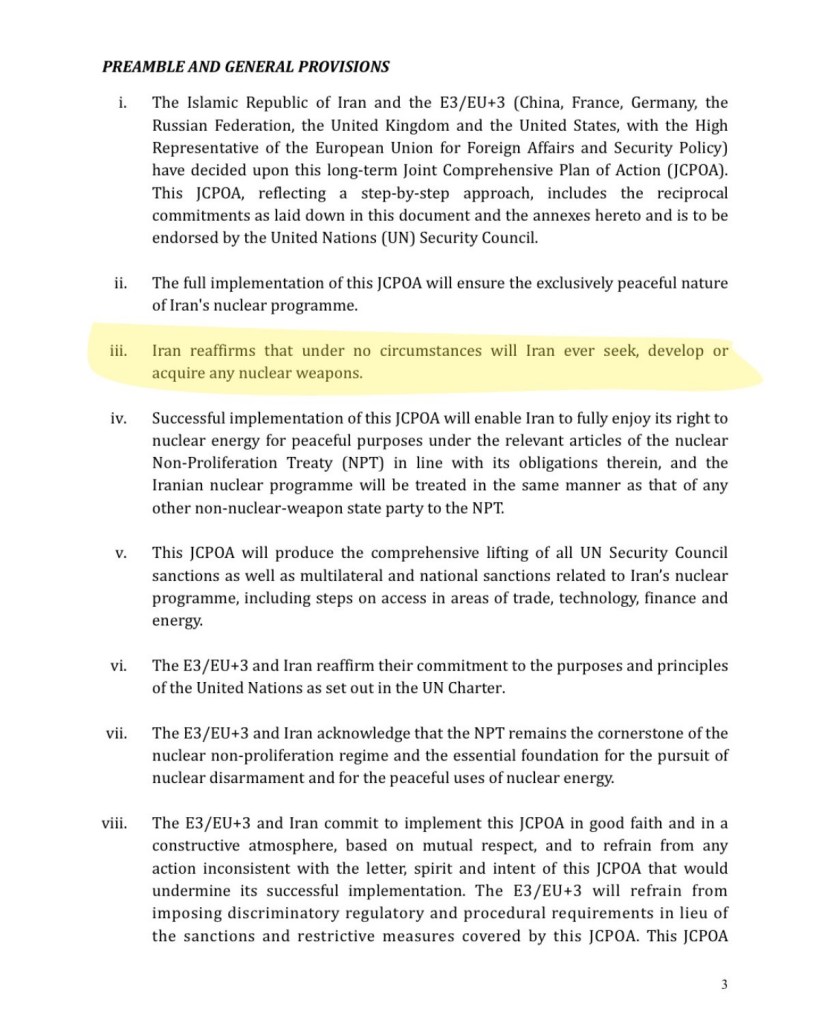
The issue, therefore, is not the absence of agreement.
It is the collapse of the framework that once sustained it.
When the agreement unraveled, so too did the mechanisms of verification, compliance, and trust. What we are witnessing today is not negotiation from first principles, but an attempt to reconstruct a system that was already built—and then dismantled.
The Problem of Asymmetry
This crisis is further complicated by structural imbalance.
Iran operates within the framework of the Nuclear Non-Proliferation Treaty.
Israel remains outside it while maintaining strategic ambiguity.
This asymmetry is not incidental. It shapes the negotiation environment itself.
You cannot demand compliance from one side while exempting the other—and still expect stability.
A Familiar Pattern
This dynamic extends beyond the Middle East.
In Jammu and Kashmir, ceasefire understandings between India and Pakistan have long existed without producing durable stability.
There, too, agreements are shaped by ambiguity and weakened by the absence of sustained structure.
Conclusion
The Middle East is not failing to reach agreements.
It is failing to sustain them.
Without a coordinated framework that aligns deterrence, diplomacy, and enforcement, every ceasefire will remain temporary—and every negotiation, repetitive.
Peace is not built by agreements alone.
It is built by the systems that ensure those agreements hold.
 Mubeen"s Blog