
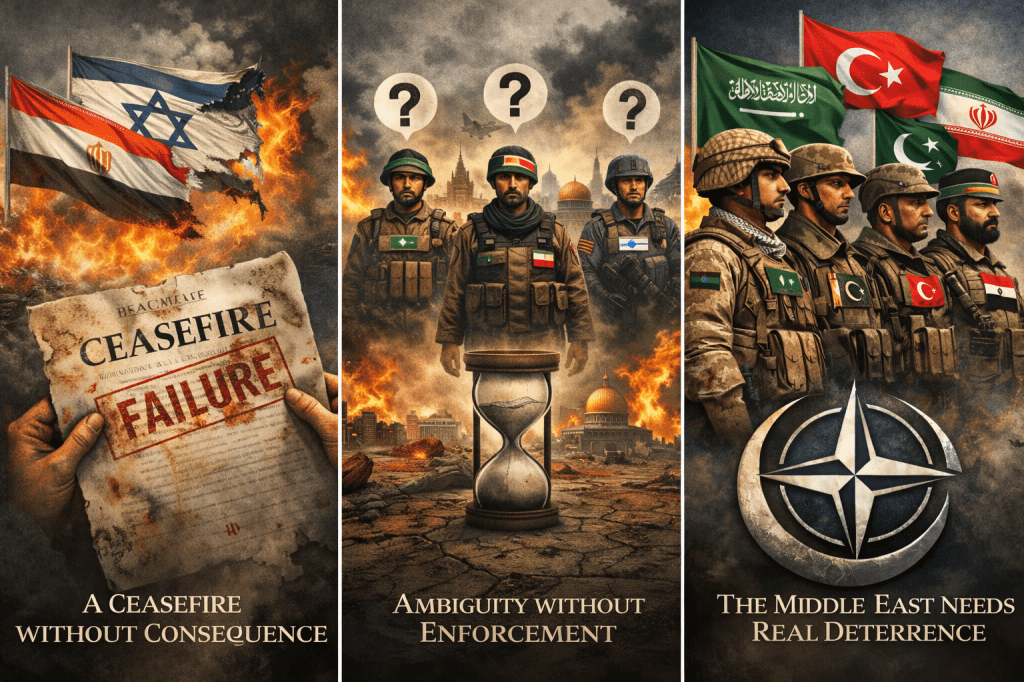
The ceasefire involving Iran, Israel, and the United States is already being described in diplomatic circles as a success.
It is not.
It is a failure disguised as a pause—one that once again exposes the absence of any credible deterrence architecture in the Middle East.
Pakistan’s role in bringing the parties to the table was significant. It created a moment of de-escalation where none seemed possible. But what has followed makes one thing clear:
A ceasefire without consequence is not stability. It is delay.
The Reality Behind the “Ceasefire”
Within hours, its contradictions became obvious.
Iran treated it as conditional and region-wide.
Israel treated it as limited and operationally flexible, continuing actions in Lebanon.
The United States accepted the ambiguity as a price worth paying for temporary calm.
This is not miscommunication. It is structured ambiguity in a system with no enforcement.
And that is precisely why it will not hold.
Diplomacy Without Power
Pakistan’s mediation did not fail. It revealed its limits.
Mediation can open channels. It cannot impose compliance—especially on actors outside its sphere of influence.
This is the fundamental flaw in the current approach to regional stability: agreements are negotiated without mechanisms to enforce them.
Without consequence, compliance becomes optional.
The Missing Element: Credible Deterrence
For years, the region has oscillated between two extremes:
- Diplomatic fragmentation
- Calls for full-scale military alliances
Neither has produced stability.
But there is a harder truth that policymakers have been reluctant to confront:
Deterrence without the credible possibility of enforcement—including military enforcement—lacks weight.
This does not mean war is the objective. It means that the option of collective action must exist for deterrence to function.
That is the principle that underpins NATO.
Rethinking a Regional NATO
The idea of a NATO-style framework in the Middle East—bringing together states such as Saudi Arabia, Turkey, Egypt, and Pakistan—is often dismissed as dangerously escalatory.
That risk is real.
But so is the alternative: a region where no collective mechanism exists to impose costs, where actions carry limited consequence, and where ceasefires are repeatedly negotiated only to be reinterpreted and eroded.
The question, then, is not whether deterrence should exist.
It is whether it will remain implicit and ineffective, or become structured and credible.
A regional framework that combines diplomatic, economic, and legal pressure with a clearly defined, collectively agreed last-resort enforcement mechanism would not increase instability.
It would introduce something the region currently lacks: predictability.
The Israel Question
Any discussion of deterrence inevitably raises the question of Israel.
At present, Israel operates with significant strategic freedom—not only because of its capabilities, but because it faces no unified regional mechanism capable of imposing consistent costs.
This freedom is further enabled by a persistent international double standard, where violations by some actors are met with immediate condemnation and consequence, while similar actions by others are absorbed into the language of “security” and “self-defence” without equivalent accountability.
This is not sustainable.
Deterrence is not about targeting a specific state. It is about ensuring that no actor operates entirely outside consequence.
A Pattern That Extends Beyond the Region
The same dynamic is visible in Jammu and Kashmir, where ceasefire understandings between India and Pakistan have long existed without producing durable stability.
There, too, agreements are shaped by ambiguity and weakened by the absence of a broader framework capable of sustaining them.
From Pause to Structure
The lesson of this ceasefire is not that diplomacy has failed.
It is that diplomacy, in the absence of structure, cannot succeed.
Pakistan created a pause. The region has already begun to move beyond it.
If future ceasefires are to hold, they must be embedded within a system that does more than facilitate dialogue. They must be backed by mechanisms that ensure shared interpretation, consistent enforcement, and credible consequence.
That includes, whether acknowledged or not, the possibility of collective action.
Conclusion
The Middle East does not lack agreements. It lacks accountability.
Until that changes, every ceasefire will follow the same trajectory:
Announced with urgency, interpreted with flexibility, and undermined without consequence.
Deterrence is not the pursuit of war.
It is the condition that prevents it.
And without it, peace will remain temporary—no matter how many ceasefires are signed.
 Mubeen"s Blog