
The latest ceasefire dynamics involving Iran, Israel, and the United States are being widely described as a diplomatic success. They are not.
They are a reminder of a deeper and more dangerous reality: in the absence of credible deterrence, ceasefires become little more than temporary pauses—fragile, contested, and easily reversible.
What makes the current situation striking is not that the parties disagree, but that they are supposed to. Iran treats the ceasefire as conditional and regionally expansive. Israel interprets it narrowly, preserving operational flexibility, particularly in Lebanon. The United States, for its part, appears comfortable with this ambiguity, using it as a tool to manage escalation rather than resolve conflict.
This is not a breakdown in communication. It is a reflection of a structural vacuum.
The Middle East today lacks a coherent framework capable of aligning regional responses and imposing consistent costs. In that vacuum, ambiguity thrives—and with it, instability.
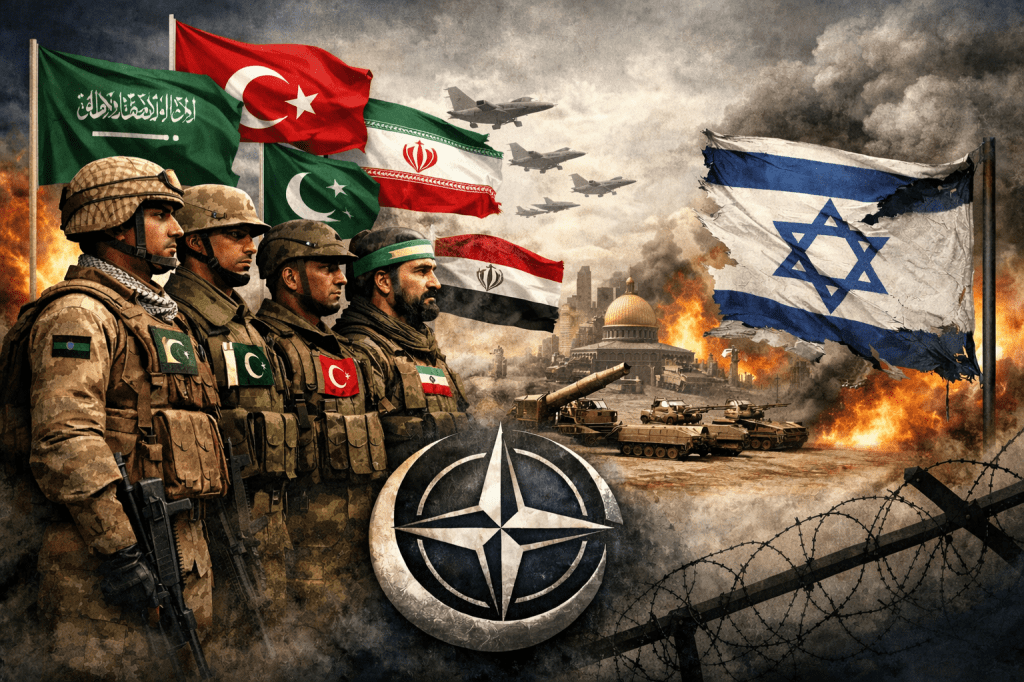
The temptation, in such a context, is to reach for a familiar model. Calls for a NATO-style alliance—bringing together countries like Saudi Arabia, Turkey, Egypt, and Pakistan—have grown louder. The logic is simple: deterrence through collective defense.
At a conceptual level, this instinct is not misplaced. The success of NATO lies precisely in its ability to make the cost of aggression unacceptably high.
But the Middle East is not Europe.
A formal military alliance explicitly positioned against Israel would almost certainly trigger immediate escalation, draw in global powers, and risk a multi-front conflict with unpredictable consequences. The region does not need more militarization. It needs more coordination.
What is missing is not power, but the ability to organize power effectively.
Israel operates with confidence not only because of its military capabilities, but because it faces no unified regional response. Iran, similarly, extends its influence across multiple theatres precisely because responses remain fragmented and inconsistent.
The result is a cycle that has become all too familiar—from the Gaza Strip to Lebanon: escalation, pause, re-escalation.
Breaking this cycle requires rethinking deterrence itself.
Deterrence is not synonymous with war. It is the prevention of war through credible consequence. And credible consequence does not have to be military compulsorily .
A more viable path lies in the creation of a coordinated, non-military deterrence framework—a strategic bloc that integrates diplomatic pressure, economic leverage, legal accountability, and narrative alignment.
Such a framework could operate through synchronized action at the United Nations and the Organisation of Islamic Cooperation, leverage influence within energy markets through bodies like OPEC, and pursue sustained legal engagement at institutions such as the International Court of Justice and the International Criminal Court.
Equally important would be the alignment of narratives across state and diaspora networks, shaping global public opinion and influencing policymaking in key capitals.
This is not a call for confrontation. It is a call for structure.
Without such coordination, ceasefires will continue to be negotiated in ambiguity, interpreted in contradiction, and violated without consequence.
The implications extend beyond the Middle East. In Jammu and Kashmir, ceasefire understandings between India and Pakistan have similarly failed to translate into lasting stability, precisely because they exist in the absence of sustained international engagement and coordinated pressure.
In both regions, the lesson is the same: ceasefires do not fail because they are violated. They fail because they are unsupported.
The Middle East does not simply need another ceasefire. It needs a framework that makes ceasefires meaningful.
Until then, every pause will remain temporary—and every agreement, an illusion.
 Mubeen"s Blog