
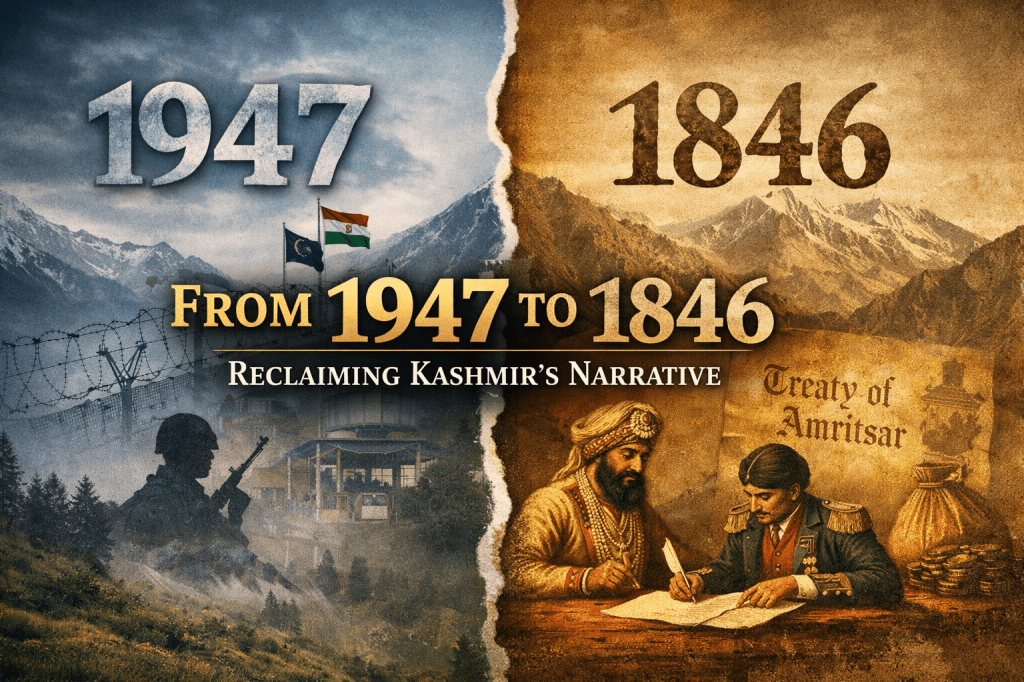
For decades, the story of Kashmir has been told—both to the world and to ourselves—through the lens of 1947. It is a story framed as a dispute between two states, shaped by wars, ceasefire lines, and diplomatic engagements between India and Pakistan.
But what if the starting point itself is incomplete?
What if the roots of Kashmir’s political reality lie not in 1947, but in 1846?
On 16 March 1846, under the Treaty of Amritsar, the British East India Company transferred control of Kashmir to Gulab Singh for 7.5 million rupees.
This was not a transition of power based on the will of the people. It was a transaction.
A land—and its people—were handed over without consultation, without consent, and without representation.
This moment is not merely historical. It is foundational.
Yet, for too long, Kashmiris have allowed their narrative to begin in 1947. In doing so, the issue has been confined within the binary of India and Pakistan—two states negotiating, contesting, and defining the terms of a dispute in which the primary stakeholders, the people of Kashmir, are often reduced to the background.
This framing has had consequences.
Internationally, Kashmir is seen largely as a bilateral issue. Calls for resolution are routinely directed toward dialogue between India and Pakistan, reinforcing the idea that the conflict is one to be managed between two states rather than addressed as a question of people and their political rights.
Over time, this has also diluted the centrality of international commitments, including the framework established through United Nations resolutions, which recognized the principle that the future of Kashmir should reflect the will of its people.
The shift toward bilateralism, particularly after the Simla Agreement, further entrenched this approach. What was once an internationally acknowledged issue increasingly became subject to state-to-state engagement, often sidelining the very population at the heart of it.
This is not to deny the significance of developments since 1947. It is to recognize that by beginning the narrative there, we accept a framework that is already limiting.
Because 1947 does not explain how sovereignty over Kashmir came to be structured in the first place.
1846 does.
It reveals that the very foundation of political authority in Kashmir was laid through a colonial-era arrangement that excluded the people entirely. It explains why questions of legitimacy, consent, and representation continue to persist across generations.
Re-centering 1846 is not about revisiting the past for its own sake. It is about reclaiming the narrative.
This is not about replacing one narrative with another, nor about diminishing the many ways in which Kashmir has been understood and articulated over time. For many, the question of Kashmir is also framed in moral and ethical terms, including resistance to injustice. Yet even within that understanding, the denial of a people’s agency in 1846 remains a critical starting point that cannot be overlooked.
It allows Kashmiris—both within the region and across the diaspora—to articulate their position beyond the confines of an India-Pakistan binary. It places Kashmir within a broader global context of colonial histories, where questions of imposed authority and denied consent are widely understood.
More importantly, it restores the focus where it belongs: on the people of Kashmir.
A narrative that begins in 1846 does not erase 1947—it contextualizes it.
It shifts the discussion from territorial dispute to historical continuity. From state rivalry to questions of legitimacy. From diplomacy between governments to the rights of a people.
For too long, others have defined the starting point of Kashmir’s story.
It is time Kashmiris redefine it themselves.
Because how a story begins often determines how it is understood—and how it is resolved.
And if the story of Kashmir is to be told truthfully, it must begin where its modern political reality truly started:
In 1846.
 Mubeen"s Blog