
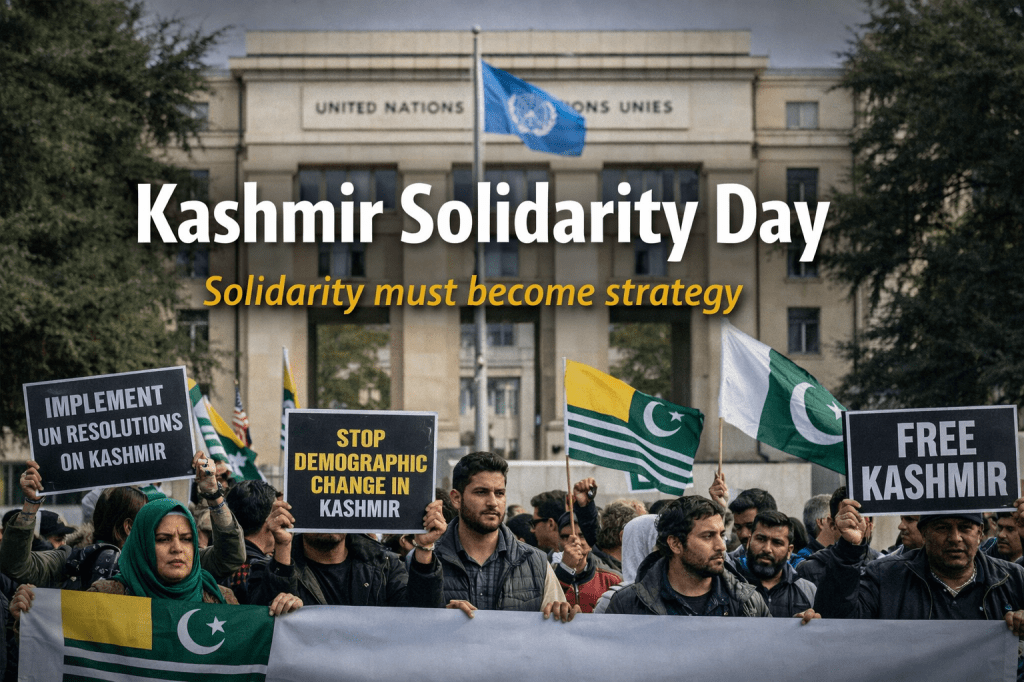
Every year on 5 February, Pakistan observes Kashmir Solidarity Day—a reaffirmation of moral, political, and historical support for the Kashmiri people’s right to self-determination. The symbolism is familiar. The speeches are predictable. Yet, five years after India’s unilateral actions of August 2019, the distance between solidarity in words and strategy in action has become dangerously wide.
This is not for lack of advice, ideas, or policy direction.
Over the past years, Kashmir House has formally submitted detailed, written policy briefs to Pakistan’s Prime minister as well as foreign minister and to Pakistan’s diplomatic mission in
Türkiye, outlining concrete, actionable steps to reposition the Kashmir issue internationally. These submissions were grounded in international law, diplomatic precedent, and the lived realities of Kashmiris—particularly those under occupation and in exile.
Kashmir Solidarity Day therefore raises a legitimate and unavoidable question:
what happens to these proposals—and diplomatic opportunities—after they are placed on record?
From Constitutional Distractions to Self-Determination
In our formal submissions to the Ministry of Foreign Affairs, we made a clear argument: Pakistan’s advocacy must remain anchored in the right of self-determination under international law, not diverted into debates around Indian constitutional provisions such as Article 370.
Article 370 was never a mechanism of liberation; it was part of India’s constitutional architecture of control.
In fact, Article 370 itself was inserted into the Indian Constitution as a temporary provision, explicitly pending the final disposition of the Jammu & Kashmir dispute in accordance with relevant United Nations Security Council resolutions. Even theoretically, therefore, the restoration of Article 370 does not resolve the Kashmir question—it merely postpones it. The core issue of final disposition, as mandated by international law, remains untouched.
Framing Kashmir around the “restoration” of Article 370 thus accepts India’s constitutional prism while sidestepping the fundamental question: how and when will the people of Jammu & Kashmir exercise their right to determine their own future? Restoration, at best, reverts to an interim arrangement; it does not address the legally required end-state.
Its abrogation in 2019 did not create a new injustice—it merely exposed the colonial nature of India’s presence in Kashmir. Continuing to frame Kashmir through this lens weakens, rather than strengthens, Kashmir’s international case.
Time-Bound Negotiations or Endless Normalisation
Our submissions to the Prime minister as well as Foreign Minister and Pakistan’s Ambassador in Türkiye stressed the need for time-bound, internationally guaranteed negotiations, with the inclusion of authentic Kashmiri representation.
Endless dialogue frameworks, unmoored from timelines or guarantees, serve only one purpose: the normalisation of occupation. Five years after August 2019, the absence of a defined diplomatic endgame has allowed India to consolidate facts on the ground while the international community adjusts to the “new normal.”
A Missed Diplomatic Opening: The Silence on Neutral-Space Talks
Most strikingly, even when a diplomatic opening briefly emerged, it failed to generate sustained discussion or strategic follow-up.
Following the most recent ceasefire understanding, the United States publicly indicated its willingness to facilitate talks in a neutral venue. This was not a mediation imposed on either side, nor a binding proposal—but it was an acknowledgment that Kashmir remains an unresolved dispute requiring structured dialogue.
Yet this offer was neither seized upon nor meaningfully debated—not in Pakistan’s parliament, not in official diplomatic messaging, and not in public discourse. Silence prevailed, allowing the moment to pass without cost to India and without strategic gain for Kashmir.
For a state that repeatedly calls for international engagement on Kashmir, the absence of a clear response to such openings raises serious questions. Diplomatic opportunities do not need to be ideal to be useful; they need to be framed, internationalised, and politically leveraged. None of this happened.
Demographic Engineering Is Not a Side Issue
One of the most urgent warnings in our policy briefs concerned India’s demographic reengineering of Jammu & Kashmir. Millions of domicile certificates have been issued, permanently altering the region’s political and electoral character in violation of international law governing disputed territories.
This is not a future risk—it is a present and accelerating reality. Yet Pakistan’s international engagement on this issue remains episodic, lacking a sustained legal and diplomatic campaign proportionate to the scale of the threat.
The Unprotected Frontline: Overseas Kashmiris
Equally concerning—and addressed in detail in our internal policy note ahead of this Kashmir Solidarity Day—is Pakistan’s failure to institutionally protect overseas Kashmiri diaspora activism.
Overseas Kashmiris have become the most credible advocates for the cause in Western political and media spaces. At the same time, they face growing risks of transnational repression: surveillance, intimidation, threats, and administrative harassment.
If overseas Kashmiris are to be treated as Pakistan’s advocacy strength, their security cannot remain an individual burden. It is a state responsibility.
Kashmir Solidarity Day should not be an annual ritual disconnected from policy outcomes. It should be a moment of strategic accountability.
The Kashmiri people are not asking Pakistan to invent new positions. They are asking Pakistan to:
• act on proposals already submitted in writing,
• protect those carrying the advocacy burden abroad,
• and respond proactively when diplomatic openings—even imperfect ones—emerge.
History will not judge how many speeches were delivered on 5 February.
It will judge whether solidarity remained ceremonial—or whether it was finally converted into strategy, protection, and international consequence.
 Mubeen"s Blog