
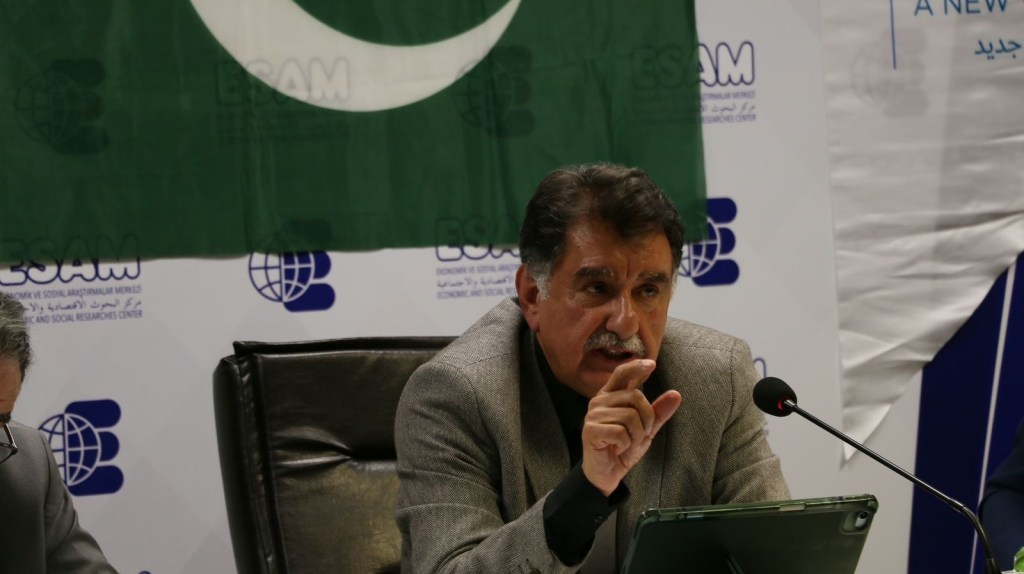
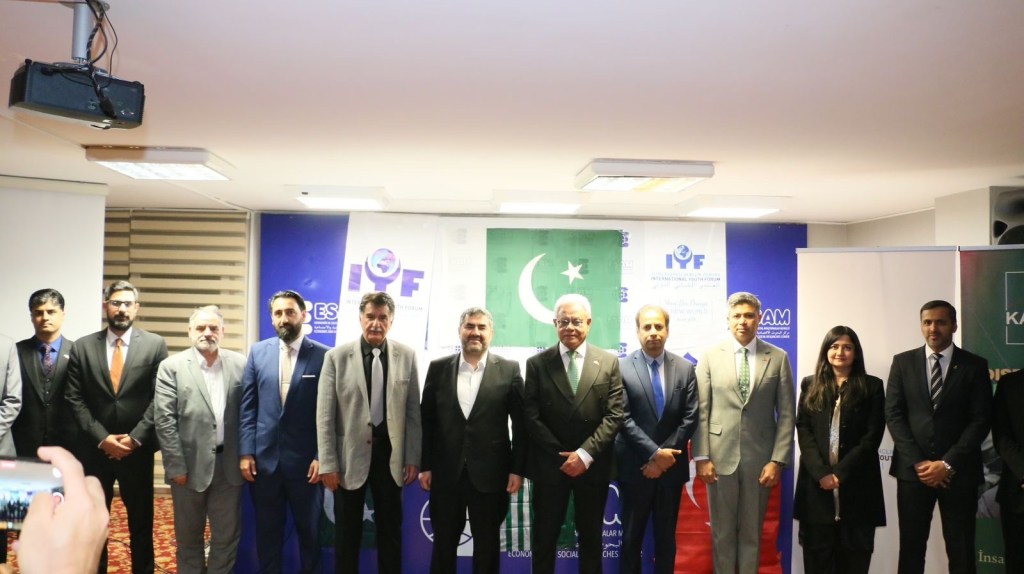
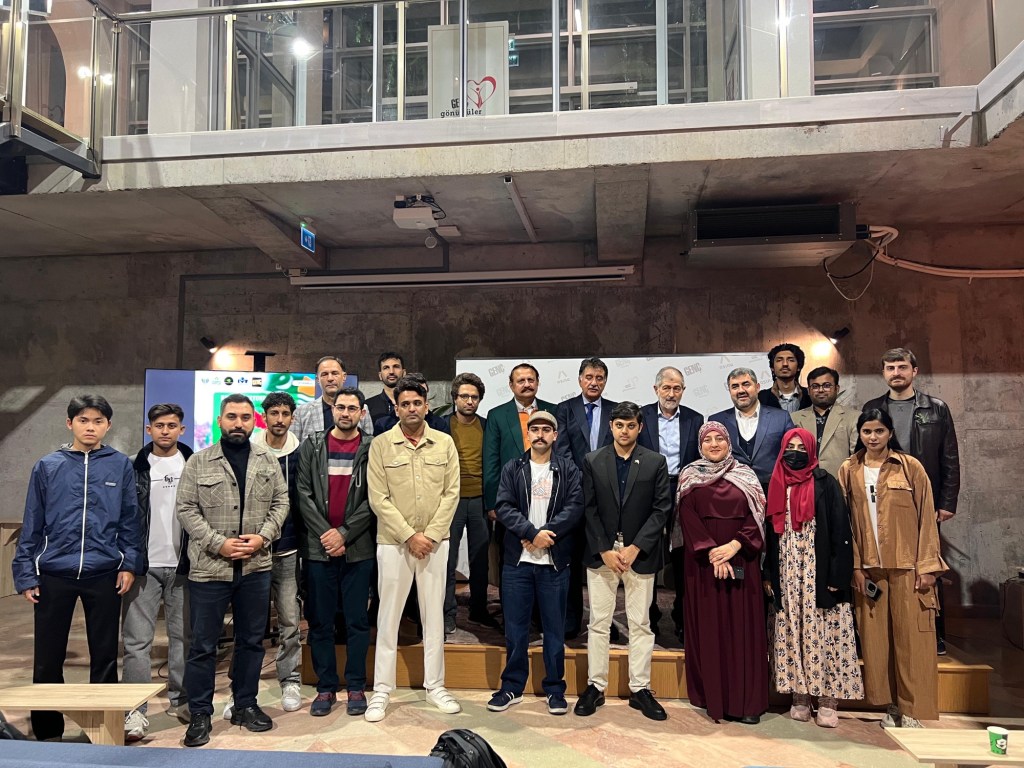
My speech in both Istanbul on 25 th as well as in Ankara on 27 th
Distinguished guests, Excellencies, Brothers and sisters in humanity,
Asalamalikum .
Today, we gather to remember a date that altered the destiny of an entire nation — 27 October 1947, the day when Indian troops landed in Srinagar under the pretext of “assistance” to the Maharaja of Jammu and Kashmir.
For Kashmiris, this was not assistance. It was the beginning of military occupation — an occupation that, seventy-eight years later, continues to shatter lives, suppress freedoms, and defy international law.
Occupation Cannot Be Self-Defence /Counter Terrorism
India has long attempted to justify its military presence in Jammu and Kashmir through the language of self-defence and counterterrorism including narrative terrorism. But as we all know, occupation cannot be self-defence or counterterrorism or even the new labelling they are promoting of narrative terrorism by which they are putting behind bars anyone who speaks out besides registering police reports (FIR) to every section of our society .
Under Article 51 of the United Nations Charter, the right of self-defence applies only when a state faces an armed attack from another state. Once a state occupies a territory, its actions there are governed by the law of occupation — a principle affirmed by the International Court of Justice in its 2004 Wall Advisory Opinion.
The Legal Framework and the Broken Promise
The United Nations Security Council, through Resolution 47 of 1948, affirmed that the future of Jammu and Kashmir was to be decided by a free and impartial plebiscite. India’s entry into the territory was accepted by the UN based on that condition. That promise was never fulfilled. Articles 1(2), 2(4), and 55 of the UN Charter enshrine the right of peoples to self-determination and prohibit the acquisition of territory by force.
The ICJ Namibia Advisory Opinion of 1971 reaffirmed that unlawful occupation cannot confer sovereignty.
The denial of the right of self determination/ plebiscite has resulted from 1947 ,killing of more than about 6-700000 Kashmiris if not a million, 150000-500000 civilians arrested from time to time , 8500 -10000 custodial killings, 12000 disappearances, 110000 structures destroyed/ arsoned, 11,170 rape cases, with injured running in hundred of thousands with at least 7000 with pellet injuries and out of them at least 700 with eye injuries resulting in blindness of different levels. Besides we have about 20000 widows as well as 1500 half widows while the number of orphans are more than 120000 .
Occupation Disguised as Counterterrorism including narrative terrorism
Over the decades, India has sought to rebrand its occupation through the lexicon of counterterrorism. The Fourth Geneva Convention and the Hague Regulations are explicit: the acts of an occupying power are regulated by international humanitarian law, which prohibits collective punishment, arbitrary detention, and restrictions on political expression. Hundreds of political leaders, human rights defenders, and youth languish in prisons across India — from Tihar in Delhi to Agra and Kot Bhalwal — imprisoned under draconian laws such as the UAPA(Unlawful andprevention act ) and PSA.(Public safety act ) which are called out by amnesty international as lawless laws .
The Case of Yasin Malik and Political Prisoners besides human right defenders
Yasin Malik, Chairman of the Jammu and Kashmir Liberation Front, who chose the path of non- violence and dialogue, is now condemned to lifeimprisonment. Alongside him, leaders such as Shabir Shah, Ashiq Hussain Faktoo , Asiya Andrabi, Masarat Alam, and Nayeem Khan remain silenced.
In case of Shabir shah he has spent more than 33 years in jail while Ashiq hussain Fakhtoo 34 ,Masarat alam 30 years .
Besides we have one of our well know human right defender Khurram pervaz in prison for last 4 years while as another well know human right defender Mr Muhammad Ahsan Untoo has been in and out of prisons and has spent his 30 years of life in Indian prisons .
In international law, such political leaders are protected persons, not criminals.
Human Rights Violations Under Occupation
The ongoing violations in Kashmir breach the ICCPR( International covenant on civil andpolitical rights ) CAT ( committee against torture ) CEDAW (convention on elimination of all forms of discrimination against women ) and CRC( Convention on the rights of children )Arbitrary arrests, torture, and denial of education to children continue. The UN Working Group on Arbitrary Detention and the OHCHR have repeatedly called attention to these abuses.
The Right to Resist Occupation
UNGA Resolutions 1514 (XV) and 2625 (XXV) affirm that peoples under foreign domination possess the right to self-determination, including the right to struggle to achieve it. The 1977 Additional Protocol I to the Geneva Conventions recognises such struggles as legitimate, not terrorism.
Double Standards in International Justice
“The world’s double standards on justice have not only deepened the suffering of occupied peoples but also eroded faith in the rule of international law itself.”
Around the world, we see that the principles of international law are invoked selectively — applied to some, denied to others.
When Russia invaded Ukraine, the International Criminal Court moved within months, issuing arrest warrants and mobilising global condemnation.
Yet, when the people of Gaza are bombarded or when Kashmir has lived underoccupation for seventy-eight years, the same institutions fall silent.
This is not only hypocrisy — it is the collapse of the very idea of universal justice.
As highlighted in recent international legal commentaries, the system of accountability has been captured by power politics: those with vetoes in the UN Security Council or strategic alliances with powerful states are shielded from scrutiny.
If international law is to have meaning, it must apply equally — from Kyiv to Gaza to Srinagar.
Kashmir cannot remain an exception to the world’s conscience. The credibility of the entire international order depends on ending this selective enforcement and holding every occupying power to the same legal and moral standard.
Accountability and International Responsibility
The Rome Statute defines torture and denial of fair trial as war crimes. Universal jurisdiction allows any state to prosecute such crimes. The 2018 and 2019 OHCHR reports urged creation of a Commission of Inquiry into violations in Jammu & Kashmir which never happened .
Call to Action: Restoring Integrity to International Justice
To correct this global hypocrisy, we must call upon both governments and people of conscience to act:
1. Governments must uphold consistency in international law — the same principles invoked in Ukraine must be applied to Kashmir and Gaza. Selective justice erodes the very legitimacy of the global legal order.
2. Member States of the UN must move beyond the paralysis of the Security Council and activate the UN General Assembly to establish independent investigative mechanisms for Kashmir under the principle of universal jurisdiction.
3. Countries of the Global South — from Türkiye to South Africa, from Malaysia to Latin America —should unite to demand reform of international justice institutions so that no power, however large, remains above the law.
4. Civil societies and individuals must insist that their governments end complicity through silence — by conditioning partnerships, trade, and security cooperation on adherence to human rights and humanitarian law.
5. The international legal community — scholars, jurists, and human rights defenders — must treat Kashmir as a living test of whether law or politics governs the world order.If the world could act with urgency in Ukraine, it cannot turn away from Kashmir.
Justice cannot depend on geography, religion, or power — it must depend only on truth.
Generations in Captivity
Entire generations have grown up under curfews and fear. The trauma of seventy-eight years cannot be measured in statistics alone.
Checkpoints replaced schools with almost every far flung villages have these check points at the start and end of villages , graveyards replaced playgrounds.
The Moral and Legal Imperative
The occupation of Jammu and Kashmir is a test of the international legal order. States have an ergaomnes (rights are owed towards all ) obligation to ensure respect for international law. Silence in the face of such violations is complicity.
Closing Appeal
India cannot claim self-defence or terrorism of any type while occupying Kashmir. It cannot imprison an entire people and call it peace. And it cannot criminalise the dream of freedom — a dream that began long before 1947 and will not die behind prison walls.On this 27th of October, as the world observes Black Day, let us reaffirm that occupation cannot outlast the will of a people determined to be free.
The world may have forgotten, but Kashmir has not .
And as long as justice remains denied, the voice of Kashmir will continue to echo — in Srinagar, in Istanbul, in London, in washington as-well as Johannesburg and all over the world and in every conscience that refuses to accept silence as peace.






 Mubeen"s Blog