
A Warning Ignored
The tragedy unfolding in Gaza today did not happen overnight. It is the result of decades of deliberate inaction. The world allowed Israel to defy UN resolutions, to expand settlements, to entrench occupation, and to silence Palestinian voices under the guise of “security.” Each time, international leaders responded not with action, but with calls for “dialogue” and “bilateral negotiations.” The result has been catastrophic: a population pushed to the edge of survival, mass displacement, cultural erasure, and today, one of the worst humanitarian disasters of our time.
For Kashmir, this is not just a warning. It is a mirror.
Kashmir’s Broken Promises
When the United Nations first addressed the Kashmir conflict in 1948, it recognized the territory’s disputed status and called for a free and impartial plebiscite to determine its future. India and Pakistan both agreed in principle. Yet more than seven decades later, no plebiscite has been held.
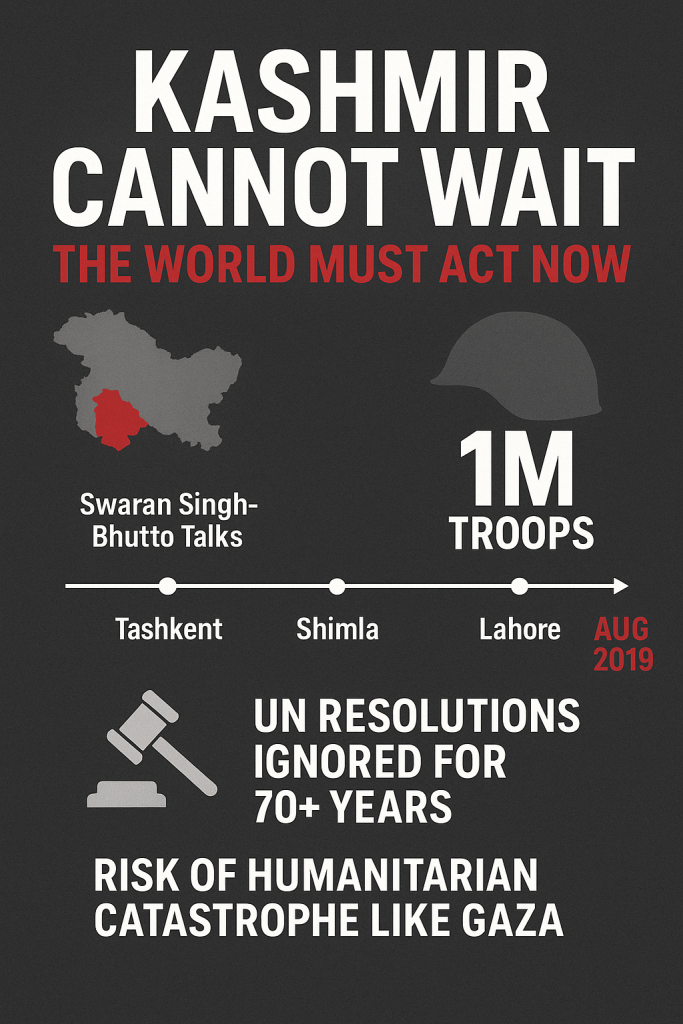
Instead, the world has fallen into the trap of bilateralism—the idea that India and Pakistan must resolve Kashmir through direct talks, with the UN standing aside. This framework has failed at every stage:
• 1962–63: Swaran Singh–Bhutto Talks — brokered by the United States and Britain after the Sino-India war, these talks sidelined the UN resolutions and set the dangerous precedent of “bilateralism.”
• 1966: Tashkent Agreement — a ceasefire, but no progress on Kashmir.
• 1972: Shimla Agreement — India insisted Kashmir was a purely bilateral matter, effectively freezing UN involvement.
• 1999: Lahore Declaration — derailed by the Kargil conflict.
• 2001: Agra Summit — collapsed after last-minute Indian resistance.
Each attempt ended the same way: India buying time while tightening its grip on Kashmir.
The End of Autonomy
The last decade has made clear that India is not interested in a negotiated solution. In August 2019, New Delhi unilaterally abrogated Article 370 of its Constitution, stripping Jammu and Kashmir of the limited autonomy it had left. This was done under military lockdown, with mass detentions of political leaders, journalists, and civil society activists. Internet shutdowns silenced dissent. New domicile laws opened the door to demographic engineering, threatening to permanently alter the Muslim-majority character of the region.
Today, nearly one million Indian troops are stationed in Kashmir—making it the most militarized zone in the world. Reports of custodial torture, enforced disappearances, and extrajudicial killings continue to surface. Books are banned, online archives erased, and Kashmiri culture is under systematic assault.
Yet the world looks away. Just as it looked away from Palestine.
The Failure of Bilateralism
Bilateralism has not just failed—it has been weaponized. India invokes it to block international scrutiny, while refusing to negotiate in good faith. Kashmiris themselves have been excluded from these talks altogether, treated as objects of negotiation rather than subjects with rights.
More than 65 years after Swaran Singh and Bhutto sat across the table, it is obvious: bilateralism is dead.
Lessons from Palestine
The Gaza catastrophe shows what happens when the international community substitutes “dialogue” for accountability. By treating Israel as above international law, world powers allowed the situation to spiral until it became almost irreversible. Sanctions, boycotts, and diplomatic isolation should have been imposed decades ago. Instead, the world normalized occupation, and now we are left with genocide.
Kashmir risks the same fate. If the world continues to hide behind “bilateralism” and economic partnerships with India, it will one day awaken to a tragedy beyond repair.
The Case for Sanctions
The time has come to move beyond empty resolutions and statements of concern. Targeted sanctions against India are both morally justified and strategically necessary.
Sanctions can take many forms:
• Diplomatic: Suspension of high-level visits, exclusion from forums until compliance with UN resolutions.
• Economic: Restrictions on arms sales, high-tech exports, and trade privileges.
• Cultural & Academic: Visa bans on officials implicated in human rights abuses; suspensions of joint cultural and academic projects.
This is not unprecedented. The world united to impose sanctions on Apartheid South Africa, despite powerful Western business lobbies opposing them. Sanctions helped isolate the regime and empower the global anti-apartheid movement. The same must happen with India.
Grassroots efforts—such as boycotts, divestment, and sanctions (BDS) campaigns—has to be put in place . But without state-backed measures, the impact will remain limited. What is needed is political courage from governments and multilateral bodies, beginning with the OIC, the UN Human Rights Council, and sympathetic nations in Europe, Africa, and Latin America.
The Moral Imperative
Silence is complicity. The UN Security Council once promised Kashmiris the right to self-determination. That promise has been betrayed for more than 70 years. Meanwhile, an entire generation has grown up under siege, denied basic freedoms, and told that the world has forgotten them.
If the world had acted earlier in Palestine, Gaza might not be burning today. If the world acts now in Kashmir, perhaps it can still prevent another catastrophe.
Conclusion
The choice is stark. Continue to hide behind bilateralism, and watch Kashmir slide into permanent occupation, cultural erasure, and large-scale violence. Or act decisively—through sanctions, international accountability, and renewed insistence on UN resolutions—to honor the promises made to Kashmiris.
Kashmir cannot wait another decade. The cost of silence is too high.
 Mubeen"s Blog