
By Dr. Mubeen Shah
Introduction
On July 13, 2025, the Indian state exposed the hollowness of its claims over Kashmir when Omar Abdullah, the present chief minister and mainstream political figure, was blocked from visiting the Mazar-e-Shuhada in Srinagar. This act symbolized the complete closure of civic space, even for those previously aligned with the Indian state ( whom Kashmiris at large label as collaborators ). It reminded the world that Jammu & Kashmir is not a functional democracy but a territory under permanent emergency, characterized by surveillance, demographic engineering, and suppression of political agency.
The incident occurred after almost a month ( precisely 19 days after )Organization of Islamic Cooperation (OIC) held its 51th Session of The Council of Foreign Ministers in Istanbul , where Kashmir was discussed with renewed urgency. On that occasion, the Kashmir Diaspora Coalition (KDC) of which I am presently the head submitted a response which was communicated to the OIC urging the OIC to move beyond symbolic resolutions toward action rooted in international law and moral responsibility.
Today escalating India-Pakistan tensions, and increased Kashmiri diaspora mobilization, the moment has arrived to implement a comprehensive roadmap for just peace in Kashmir.
Strategic Continuity: A Framework Rooted in Justice
I had made some proposals regarding the strategic framework I first articulated in 2020 kashmir-regional-and-international-dimensions ( https://economykashmir.home.blog/2020/07/02/kashmir-regional-and-international-dimensions/ ) elaborated further in model-of-settlement-of-kashmir( https://economykashmir.home.blog/2020/07/01/model-of-settlement-of-kashmir/ ) while participating in zoom calls and which are documented .
The core principles I laid out in 2020 remain unchanged and now gain deeper international legitimacy:
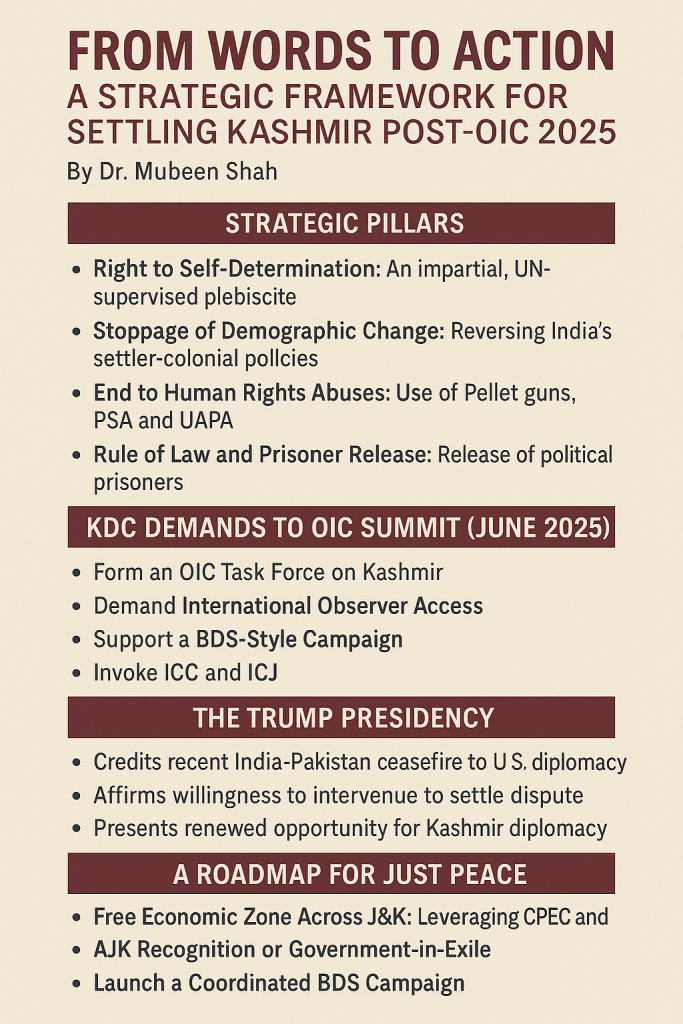
1. Right to Self-Determination:
Enshrined in UN Resolutions 47 through 122, this principle is non-negotiable. It calls for a UN-supervised plebiscite—a promise the world has yet to fulfill.
2. Stoppage of Demographic Change:
The systematic dilution of Kashmiri identity through the Domicile Law is a violation of the Fourth Geneva Convention. India’s settler-colonial project must be reversed.
3. End to Human Rights Abuses:
India must halt its use of preventive detention laws like PSA and UAPA, and lift the military siege that has turned Kashmir into an open-air prison.
4. Prisoner Release and Rule of Law:
Kashmiris imprisoned since the abrogation of Article 370 & before that date must be released. India’s courts have failed to uphold even basic liberties; international mechanisms must now intervene.
The Trump Presidency: A Renewed Window for Diplomatic Intervention
The return of President Donald Trump to the White House in 2025 has reshaped the strategic context of Kashmir diplomacy. In a recent statement, President Trump publicly claimed credit for the latest ceasefire between India and Pakistan, describing it as the result of “quiet but firm American diplomacy.” More importantly, he signaled that his administration is willing to directly intervene in the Kashmir dispute, reviving his 2019 offer of mediation.
Unlike previous administrations that deferred to India’s “bilateralism” narrative, Trump views the Kashmir conflict through the lens of deal-making and global conflict resolution. His political persona, centered around decisive interventions and legacy-building, creates an unexpected yet powerful opening.
For Kashmiri diplomacy, this presents a unique opportunity:
• The current ceasefire creates breathing room for pushing confidence-building measures such as prisoner release, demilitarization, and international access.
• The Trump administration may be persuaded to back a regional economic framework—including my longstanding proposal of a Free Economic Zone across both sides of J&K—to position Kashmir as a peace corridor.
• The Diaspora particularly the Kashmiri-American diaspora and advocacy allies must immediately ramp up engagement with this administration, framing Kashmir not as a liability but as a peace dividend for South Asia and U.S. strategic interests.
Whether one agrees with Trump’s politics or not, his presidency offers a renewed diplomatic window—one that must be seized with urgency, focus, and realism.
The Path Forward: A Phased, Practical Roadmap
1. Free Economic Zone for Entire J&K
My longstanding proposal for designating both Indian- and Pakistani-administered Kashmir as a Free Economic Zone (FEZ) has gained renewed urgency. With CPEC gaining momentum and China’s increased interest in regional stability, declaring both AJK (Azad Kashmir ) and IOJK ( Indian occupied Jammu Kashmir ) as FEZs:
• Provides economic hope to the youth.
• Positions Kashmir as a bridge for peace rather than a nuclear flashpoint.
• Creates conditions for functional autonomy pending political settlement.
2. Recognition of AJK or Government-in-Exile
If India refuses international access and dialogue:
• Pakistan must consider declaring Azad Jammu & Kashmir an independent state, much like the PLO or Palestine, and seek international recognition.
• Alternatively, a Government-in-Exile should be declared, possibly based in Turkey or Malaysia, with representation from AJK and the global Kashmiri diaspora.
3. Mobilize Legal and Institutional Mechanisms
• Engage the International Criminal Court (ICC) for war crimes in Kashmir.
• Move to the International Court of Justice (ICJ) through friendly states (e.g. Gambia, Malaysia) to challenge India’s demographic changes and use of torture.
• Highlight misuse of PSA and UAPA as violations of civil and political rights.
4. Launch a Global Kashmir BDS Campaign which I had written in 2020 also (https://economykashmir.home.blog/2020/07/04/kashmiri-bds-boycott-divestment-sanctions-movement-against-india/)
Inspired by the Palestine solidarity movement, we must:
• Target international firms complicit in surveillance, arms sales, or occupation infrastructure.
• Picket and pressure entities investing in Kashmir’s illegal colonization.
• Use diaspora networks to stage global campaigns in front of consulates, corporate offices, and international forums.
5. Harness Cultural Resistance
• Support musicians, filmmakers, writers, and athletes who carry the Kashmiri story into the global conscience.
• Build platforms for young Kashmiri voices to counter the Indian state’s disinformation.
• Commission new works of resistance art and documentary journalism.
⸻
Conclusion: This Is the Moment to Act
History is shaped by those who combine moral clarity with strategic foresight. For too long, Kashmir has been trapped between rhetorical support and geopolitical compromise. But the global shift in perception—helped by the COVID-era understanding of lockdowns, the Ukraine war’s reminder of international double standards, and the enduring Palestinian struggle—has opened space for Kashmir on the world stage.
The world can no longer ignore the reality of Kashmir.
The time for resolutions alone is over. The time for actions rooted in justice, rights, and international law has begun.
Let us move from words to action—together.
 Mubeen"s Blog